Wednesday, 31 October 2007

BR: A Separate Peace (John Knowles)

Amazon Link: A Separate Peace

Gene is an insecure teenager, unable to accept the friendship of a talented, athletic, confident boy, Phineas, as being without dubious intent. The year is 1942 and both boys are students at an elite private boys’ school in New England. They are one year away from being of age to enlist for war. While the seventeen year old seniors engage in physical conditioning in preparation for battle, Gene and his friends enjoy comparative freedom, and they, under Finny’s inventive guidance, take full advantage of it.

These are smart, well behaved boys, respectful and capable. Finny is a star athlete, handsome, optimistic, cautiously reckless but never hurtful or cruel; Gene’s academic success and natural intelligence has him on track to be star of the school. They are equals, admired, respected and full of potential, yet Gene fails to recognise his worth and, in a moment of unthinking selfishness, he sets the stage for tragedy.

This isn’t a novel about regret, or guilt, or tragedy (though it is all those), it’s about growth, how people shape the lives of others, of how a boy becomes a man in the shadow of war, of how friends shape friends, and how people mature through the influence of others.

Philosophy, psychology and history combine to form the layers of this book, and it would take multiple readings to uncover them all, to reflect, mirror-like, the lessons within the words.

Until now, in spite of everything, I had welcomed each new day as though it were a new life, where all past failures and problems were erased, and all future possibilities and joys open and available, to be achieved probably before night fell. Now, in this winter of snow…, I began to know that each morning reasserted the problems of the night before, that sleep suspended all but changed nothing, that you couldn’t make yourself over between dawn and dusk. Phineas however did not believe this.
There are very few books I would consider re-reading, that I can say without doubt are capable of changing my view of the world, of my place in it, of life -- that are so powerful, yet subtle, that one reading of them fails to capture all but the most obvious of their nature. This is one.

Rating: ******* (out of *****).

Tuesday, 30 October 2007

BR: Maralinga, My Love (Dorothy Johnson)

Book Link: Maralinga, my love

During the 1950s and 60s the British tested nuclear weapons at several remote sites in South Australia. Much secrecy surrounded the tests, the extent of contamination and the effectiveness of the British clean-ups. This novel, a fictional account, explores one man’s experiences at Maralinga and his resultant passion to see the truth revealed and remedial work carried out.

The protagonist in this novel, Graham Falconer, a twenty-one year old Australian, works with for the British at Maralinga to set up the test sites. He and his mates are told little about the tests and reassured that the work they do is safe as long as they follow the rules and take precautions. Their behaviour is monitored, regulated and any breach (including helping dispossessed Aborigines) is punishable. Displays of friendship (mateship) is discouraged and division is marked between the ranked British officers and the Australians. It's not what the Aussies are used to, and many take out their frustrations in violent brawls that end before they've even begun. It's a forced environment, and many can't wait to get out.

Graham keeps his head down, thinks of his soon to be wife in Melbourne, and does his job. He befriends an Australian physicist, Charlie Hamilton, and is assigned to work with him. They witness the first detonation together and Graham is awestruck by the power, the sheer destructiveness of it. As the months go by, more tests are carried out and Graham moves between ranges, recording radiation in the fallout zones.

In 1963, the British go home, leaving the Australians to clean up. Graham is part of the clean-up crew, and when he finds unusually high radiation readings in areas considered to be safe and cobalt pellets in the fallout zone, his indifference turns to concern.

The novel follows Graham over fifteen or so years, through his marital life, his return to school to study for a physics degree, his graduation and employment in England and Australia. Maralinga drives his career and leads him into government where he hopes to uncover the truth.

This is a fictional account based on the author’s research of atomic testing at Maralinga and sites nearby. While an entertaining (and disturbingly informative) read, the novel lacked clear time transitions, relying on events rather than reminding the reader of dates or the ages of the main characters. Some minor technical issues also bothered me, including the overuse of exclamation points in dialogue, and the skimpiness of dialogue. Whenever the characters sat down to talk, the narrator stepped in and summarized the dialogue, thus denying the reader the experience for themselves. I enjoy good dialogue, and I missed it in this novel.

Worse though, it seemed that Dorothy opted to sit on the fence about this matter. Despite Graham's persistence in putting himself through school so he could exert influence, his efforts lacked conviction, the story lacked real meat. Overall, I had hoped for more.

Rating ** (out of *****)

Wednesday, 24 October 2007

BR: Of a Boy (Sonya Hartnett)


Book Links: Of a Boy (US title: What the birds see)

Nine year old Adrian, abandoned by his father, his mother incapable of caring for him, lives with his grandmother (Beattie), a hard – but not unloving – woman who struggles to connect with, and nurture the quiet, sensitive boy. He calls her grandmonster, but not to her face.

Rory, Beattie’s twenty-five year old son and one of her three dysfunctional children, lives with them. He exists as a broken shell after driving his sports car into a telephone pole, a reckless move that cost him his best friend. The other boy did not die, but death, Rory thinks, would have been the better alternative than the living, breathing vegetable he became.

Every character in this book is broken, dysfunctional, wounded in some significant way. As most of the characters are children, it makes for a hard read, but a necessary one.

The story opens with the disappearance of three children, the Metfords, who headed out to get icecream and never came back. Adrian fears that he could disappear, just like those children did, and he wonders why anyone would want to steal a child. He thinks he has nothing to offer, he thinks he’s invisible… often-times he wishes he was.

This is a sad story of a lonely boy cast off onto a caregiver who loves him, but doesn’t want him. He is well cared for, loved, tended to, like a garden, but he is a boy who needs more… much more.

The winner of several Australian literary awards, shortlisted for another, this is a novel that sliced into my chest, carved it up and left me bleeding for days after reading it. Its subtle power is inspiring, and devastating.

The writing... well, it speaks for itself:

Adrian shrugs, hopelessly confused. Joely is touching her nose with her tongue, chin tilted to the clouds. Giles gazes at nothing with the absent expression of the bored toddler; he balls a hand into his sister’s palm and hangs his weight off it, sleepily closing his eyes. The ironwork contorts round the faces of the children, frames them with wrestling coils. The evening has come down heavily, a haze of pearly-grey. Few cars travel this nowhere road, and the cold birds are all silent. Adrian comes cautiously forward, touching his wrists to iron. His lips and eyelids feel like icy wounds, his breath lingers under his nose. He hears himself asking, ‘Where did you come from?’

I have no more words… this book hurts, but damn, it's good!

Rating: ***** (out of *****)

Friday, 19 October 2007

BR: Eucalyptus (Murray Bail)


Amazon Link: Eucalyptus

A man, who has a daughter (Ellen) and an obsession with collecting and growing eucalypts on his New South Wales property, announces that a suitor who can identify every one of the near 500 species, will win the hand of his daughter. The girl, an unusual creature, skin speckled with brown and a habit of walking around her father’s vast property stark-naked, is disinterested in her father’s challenge.

Men come from miles; she dismisses them all, unaffected by their failure, unimpressed by their various shapes and sizes. It seems no man, aside from her father, could achieve such a feat, until Mr Cave, a eucalyptus expert from Adelaide, sets up residence in the farmhouse and proceeds to work his way through the paddocks of trees. He shows real potential, and Ellen is worried.

Another man, a mysterious drifter, appears on the property and bewitches her with stories. As Mr Cave toils through day after day of naming species, this nameless stranger occupies Ellen’s thoughts and entertains her with quiet tales of lost love, missed opportunities, failed romances; people from cities she has never seen. She is intrigued, and she is falling in love.

I won’t ruin the ending for anyone who cares to read, but this is a modern fairytale with improbable events and odd characters. The writing is lyrical, the story interspersed with stories inspired by eucalyptus species, the narrative etched with wistfulness.

I started off with great interest, impressed by Mr Bail’s writing style and delighted by the Australian setting and focus on eucalypts. As an aside, for a while I thought I might be an ecologist/botanist, and so I have a greater interest than the norm in native plant and animal species. Now that I’m a writer, I appreciate writers who capture our native landscape and highlight it.

My favourite scene in this book is one where the writer focuses attention on the River Red Gum, a tree I would happily be buried under (or have my ashes scattered under… whichever).

The most common eucalypt in the world is the Red Gum. Hundreds on Holland’s property alone followed the river. And yet – small example of the unexpected – for all its widespread distribution, it has not been found in Tasmania.

Over time the River Red Gum (E. camaldulensis) has become barnacled with legends. This is only to be expected. By sheer numbers there’s always a bulky Red Gum here or somewhere else in the wide world, muscling into our eye, as it were; and by following the course of rivers in our particular continent they don’t merely imprint their fuzzy shape but actually worm their way greenly into the mind, giving some hope against the collective crow-croaking dryness. And if that’s not enough the massive individual squatness of these trees, ancient, stained and warty, has a grandfatherly aspect; that is, a long life of incidents, seasons, stories.

Stories are the glue that binds this book together. Without the stories -- related only by their having been inspired by a particular eucalyptus species -- there would be no story.

This book won literary awards. Despite the quality writing, I can't quite see why. I appreciate its uniqueness, the depth of research, the well crafted writing, but I had hoped for more.

Rating ** (out of *****)

Sunday, 14 October 2007

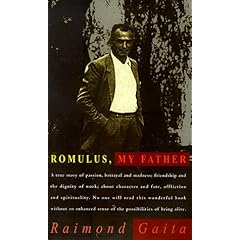
BR: Romulus, My Father (Raimond Gaita)


Amazon Link: Romulus, My Father

Written as a recollection, not as a present experience, this story spans 50 years in just over 200 pages. There is no room for detail, for sharing the journey, rather the reader bears witness and connects through empathy. It’s like sitting in an older person’s living room and listening to their life story – something I very much enjoy doing if the experiences are vastly different from my own, and these are. Through Raimond’s words, he offered me an opportunity to witness his childhood, the observations and interactions he had with his parents, family friends, and the wider relevance of immigrants assimilating into the Australian culture – something my own mother and grandparents did around the same time as Raimond’s.

Romulus Gaita (Raimond's father), an immigrant to Australia from Yugoslavia, lived an unthinkably difficult life. Raised with violence, Romulus knew pain, hardship, living without. He strived to shield his son from the same and this book proves his success. Through Raimond’s memories, I developed a deep respect for Romulus, his family, the people he interacted with and for the toll mental illness takes.

Romulus chose a passionate woman in Christiana (Raimond’s mother), but she came with huge problems. Romulus’ pride, his high morals, his honour, prevented him from blaming her for her failures (and there were many), and it also had him supporting her when she betrayed him to another man (many other men, it seems). A lesser man would have cast her aside: Romulus did not because he said there is no worse fate than mental illness, and Christiana was deeply unwell. The pride and compassion of this man was inspirational, it highlights the difference between cultures and the generosity of spirit that allowed him to co-exist with Australians who did not immediately appreciate and share those virtues.

Raimond writes with pride, with strength, and I can’t help but share the admiration he holds for his father and for the people he writes about. As a child, Raimond experienced grief, loss, abandonment, confusion that no child should ever experience, yet he never doubted his father’s love for him, and he was never without support.

This story is amazing, made all the moreso because it’s true.

Rating ***1/2 (out of *****)