Showing posts with label American. Show all posts

Sunday, 2 November 2008

BR: Peace like a River (Leif Enger)

Amazon Link: Peace like a River
The back cover reads:
Leif Enger's best-selling debut is at once a heroic quest, a tragedy, and a love story, in which "what could be unbelievable becomes extraordinary" (Connie Ogle, The Miami Herald). Enger brings us eleven year old Reuban Land, an asthmatic boy in the Midwest who has reason to believe in miracles. Along with his sister and father, Reuben finds himself on a cross-country search for his outlaw older brother who has been controversially charged with murder. Their journey unfolds like a revelation, and its conclusion shows how family, love and faith can stand up to the most terrifying of enemies, the most tragic of fates.
I'm not particularly religious, I don't believe in 'God', at least not in the 'go to church on Sunday's and say your prayers at night' type of belief. This book is riddled with miracles, real Jesus-as-our-saviour type miracles. It has a character who walks on air, a whole car and caravan being made invisible so as to evade police observation, a gas tank that never runs dry, a boy surviving a gunshot wound after he has been declared dead... and, you know what, I loved (and believed) every bit of it.

I didn't read this book from beginning to end in one sitting, in fact it took me quite some time because it's a slow book and not much happens in any great hurry, but each time I came back I settled right in and felt at home. Reuben is an adorable character. He's gutsy and young and vulnerable and real. His younger sister, Swede, is a novelist and poet, gifted with incredible insight and a vocabulary that puts mine to shame, and she's only nine years old.

Davey is the quintessential older brother: sixteen years old, fiercely protective of his family and those he loves. His honour lands him in deep trouble when he kills two intruders in the family home. His lawyer claims self defence, but there's history between Davey and the two young men, a history that unravels to reveal murderous intent.

With Davey in prison and their father out of work, things are looking pretty bleak for the Lands family. Until Davey busts out of prison and disappears. The FBI send a man out to interrogate the family, but he finds out very little because they don't know where Davey has gone. The situation enters a stalemate with the FBI man unwilling to let them out of his sight, and the Lands having nowhere to go and no way to get there. To quell her anxiety, Swede composes maudlin poetry while Reuban concentrates on breathing.
Miraculously, a local man bequeathes a car and caravan to the family, and a tank of gas that never runs out. Off they head into the barren winter wilderness in search of their lost brother and wayward son, managing to evade the FBI agent and local police as they pass through small towns.

When winter storms move in and the highway is closed, they are forced to spend a night off the highway with a widower, Roxanna. She's a friendly, ferocious woman who takes them in as her own. What was going to be one night, becomes two, three, more. They settle in, making a family for themselves but never far from their minds is Davey.

One night Reuban sees Davey on a horse at the boundary of the property. He braves the winter cold with his gummy lungs and meets with his brother. Here starts a series of clandestine meetings whereby he learns that Davey is holed up with a derelict outlaw, Waltzer, and his child bride, a brutal man with a sordid past.

Reuben is torn, bound to secrecy by his brother but fearful of the man who holds so much sway over Davey's safety. When the FBI agent, who by this stage has tracked them down, goes missing, Reuban believes Waltzer has murdered him and he's afraid for Davey's life. He tells his father who in turns tells the FBI agent and a posse is put together to hunt the men down. Reuban is dragged along and his guilt at betraying his brother is palpable.

The story takes a dramatic turn at this point and I won't give it away, but the ending is satisfying and rewarding, if not... miraculous. As Reuban says, 'Make of it what you will'.

Rating: **** out of five

Saturday, 18 October 2008

BR: The Dogs of Babel (Carolyn Parkhurst)

Amazon Link: The Dogs of Babel


The back cover reads:
This exuberantly praised bestseller - one of the year's most admired and enjoyed fiction debuts - tells the story of a man's quest to solve the mystery of his wife's death with the help of the only witness: their dog, Lorelei. Written with a quiet elegance and a profound knowledge of love's hidden places, The Dogs of Babel is a work of astonishing and lasting power - a story of marraige, survival and devotion that lies too deep for words.

This novel is one that I bought in the US last year. In fact, the last four books that I read, excluding the most recent, were books purchased last year in the US. Evidently I'm subconsciously clearing the shelves for the new books I will buy during my visit early next year.

This is a charming story, dark in places, beautiful in others, odd and disturbing when Paul's obsession with teaching his dog to talk leads him to a small group of people who believe that surgically altering the profiles of dog's jaws will give them the ability to speak.

Paul is a grieving husband, obsessed with finding out the truth of his wife's death. She fell from a tree in their backyard and the dog was the only witness. What was she doing up there? Why did she fall? Why did she cook the dog a steak before climbing the tree, and why did she rearrange their entire collection of books before she died?

Lexy left her husband a myriad of clues and he unravels them as he recalls his marraige, the highs and lows, the special things they did together and Lexy's sometimes unusual behaviour that didn't make him love her even less, but served as clues to her eventual demise.

I understand why this book made the best-seller's list, why it's a book-club book, and why it has such high praise and quality reviews. It is a quality novel that crosses genres. It has mystery and romance, it's not too long and it's not too challenging. It deals with complex issues in a manner that is accessible and not overly maudlin. It gives the reader an experience of mental illness from the outside, and it gives the reader a fluffy, light ending which readers can feel good about.

It's no wonder this is a book-club favourite and a best-seller, it packages up the nasty stuff and makes it palatable for the masses. Unfortunately I'm not one of the masses.

Paul's obsession to teach Lorelei to talk was endearing if not a little disturbing, and his embroilment with the crazy dog mutilators gave the story an aspect of danger and served to illustrate to the protagonist the error of his own ways. These are nice techniques, but they felt orchestrated rather than organic. I'd have preferred to see Paul work out for himself that the dog talking thing was flawed, which would have been much harder to pull off for the writer but inherently more rewarding for the reader.

Lexy's creativity worked well with the story and her painting of masks, especially the death masks, fed toward the eventual reveal, but the choice of making her a gifted artist is subtexturally stereotypical.

From the beginning this book didn't quite gel. The structure is mature and the pacing, though a little slow, kept me interested but the sadness is perfunctory and the writing lacked honesty. As for the whole handling of mental illness and suicide... this book sends completely the wrong message.

Readers of romance novels will enjoy this, but anyone who is seeking to understand the human condition won't get much out of it at all.

Rating: ** out of five.

Saturday, 11 October 2008

BR: Always running (Luis J. Rodriguez)

The back cover reads:

By age twelve, Luis Rodriguez was a veteran of East L.A. gang warfare. Lured by a seemingly invincible gang culture, he witnessed countless shootings, beatings,
and arrests, then watched with increasing fear as drugs, murder, suicide and
senseless acts of street crime claimed friends and family members.
This book was written in 1993, and revised with an updated introduction in 2005. Luis wrote the book, in a large part to appeal to his son in an attempt to deflect the young man from the same path he took. The introduction of this version informs the reader that his son is serving a 28 year prison sentence for three counts of attempted murder. It's a sobering start to a serious piece of work, written as a novel but with the truth of autobiography, it reads with the punch of a newspaper editorial and the poetry of lyrical prose – readable, accessible and haunting. It has lessons applicable to us all.

Luis is the son of Mexican immigrants. His parents were forced to move to the US after Luis' father, a former school principal, fell out of favour with the local chieftains – powerful men with political connections – his transgressions so dire that he was imprisoned on trumped up charges, fed food scraps from a can, treated with contempt. The family finally escaped to America and sought to build a life in the face of poverty, homelessness and social rejection.


Our first exposure in America stays with me like a foul odor. It seemed a strange world, most of it spiteful to us, spitting and stepping on us, coughing us up, us immigrants, as if we were phlegm stuck in the collective throat of this country.
Luis is one of several children but his closest and harshest sibling relationship is with Rano, his older brother.
In fact, I remember my brother as the most dangerous person alive. He seemed to
be wracked with a scream which never let out. His face was dark with
meanness, what my mother called maldad. He also took delight in seeing me
writhe in pain, cry or cower, vulnerable to his own inflated sense of power.

Displaced at home, misunderstood at school, surrounded by violence and gangs, social exclusion and minimal prospects, Luis and several other boys with similar backgrounds form a gang. They are kids, barely teenagers yet they begin their evolution into a life where alcohol and drugs numb pain, violent crime signifies strength and all that matters is blind, unerring loyalty to
their homies, regardless of personal or moral cost.

Along the spine of the night, through the shrubbery, on the coarse roads, past
the peeling shacks, past the walls filed with the stylized writing that
proclaimed our existence, past La India's shed where boys discovered the secret
of thighs, in the din of whispers, past Berta's garden of herbs and midnight
incantations, past the Japo's liquor store, past the empty lots scattered around
the barrio we called "the fields" overlooking Nina's house, pretty Nina, who
lavished our dreams, there you'd find the newest and strongest clique. There
you'd find the Animal Tribe.

Before long, the Animal Tribe is forced to disband, their members split up and absorbed by larger gangs of older boys, young men with bloodied pasts, murder and revenge in their veins. The initiations into these gangs are brutal, but Luis has grown up with pain and takes the beatings just as he takes everything else that happens to him – with numb acceptance.

Everything lost its value for me: Love, Life and Women. Death seemed the only door worth opening, the only road toward a future. We tried to enter death and emerge from it. We sought it in heroin, which bears the peace of death in life. We craved it in our pursuit of Sangra and in battles with the police. We yelled: You can't touch this!, but Come kill me! was the inner cry. In death we sought what we were groping for, without knowing it until it caressed our cheeks. It was like an extra finger in the back of our heads, pressing, gnawing, scraping. This fever overtook us, weakening and
enslaving us. Death in a bottle. In spray. In the fire eyes of a woman, stripped of soul and squeezed into the shreds of her humanity.

As a young adult, Luis begins what will be a long journey toward turning his life around. He was born with a gift of writing, and he started this book when he was 15 years old though no-one believed that a low achieving Mexican boy could (or would want to) write a novel. As he matured, he developed a healthy distaste for the daily horror, the deaths and violent reprisals, the fear of someone he loved being taken out by a warring gang. Through school, he learned that there were options and alternatives, he gained a voice, organized activities, appealed to his homies to stop the madness though very few would listen.
I arrived at a point which alarmed even me, where I had no desire for the
internal night, the buoyancy of letting go, the bliss of the void. I require
more, a discipline as a bulwark within which to hold all I valued, a shield
against the onslaught.

On a broader scale, some people listened and are still listening, others don't and never will. While he has a voice, Luis will spread his message and though he failed to save his son from prison and accepts responsibility for at least some of Ramiro's despair, the lessons he has learned and the hope he shares will save many others. That is without a doubt.

Rating: ***** out of five

Thursday, 2 October 2008

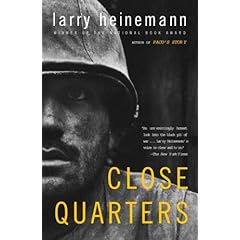
BR: Close Quarters (Larry Heinemann)

The back cover reads:

Like many other recent high-school graduates in the 1960’s, Philip Dosier found that if he didn’t have plans for himself, his country certainly did. Shipped off to Vietnam to fight in a war he knew next to nothing about, he found himself in a world of violence, fear, heat and squalor unlike anything he ever thought
could exist.

Told in the unflinchingly accurate language of the field soldier – fast, rough slang that becomes a kind of surreal poetry – Close Quarters is the story of Dosier’s year in Vietnam.

A classic of war fiction, it is the harrowing account of a decent young man who becomes an embittered combat veteran and how he makes his way back to the world he left behind.

The reader meets Philip on his arrival in Vietnam, his introduction to what will be his life for the next twelve months. He’s naïve, scared and out of place. Everything he sees and experiences is new and disorienting. The men who are already in active duty are dirty and dead eyed, rough and brutal, nothing like the guys he knows back home. All the preparation, training, instruction haven’t prepared him for the reality of what he faces, but he man’s up because he has no other option.

I stood stiffly with my feet well apart, parade-rest fashion, at the break in the barbed-wire fence between the officers’ country tents and the battalion motor pool. My feet and legs itched with sweat. My shirt clung to my back. My shaving cuts burned. I watched, astonished, as the battalion Reconaissance Platoon, thirty-some men and ten boxy squat-looking armored personnel carriers – tracks, we called them – cranked in from two months in the field, trailing a rank stink and stirring a cloud of dust that left a tingle in the air. One man slowly dismounted from each track and led it up the sloped path from the perimeter road, ground-guiding it, walking with a stumbling hangdog gait. Each man wore a sleeveless flak jacket hung with grenades, and baggy jungle trousers, the ones with large thigh pockets and drawstrings at the cuffs. The tracks followed behind like stupid, obedient draft horses, creaking and clacking along, and scraping over rocks hidden in the dust. There were sharp squeaks and irritating scratching noises, slow slack grindings, and the throttled rap of straight-pipe mufflers, all at once. And the talk, what there was, came shouted and snappy – easy obscenities and shit laughs. It was an ugly deadly music, the jerky bitter echoes of machines out of sync. A shudder went through me, as if
someone were scratching his nails on a blackboard.

The men walking and the men mounted passed not fifteen feet in front of me. A moult, a smudge of dirt, and a sweat and grit and grease stink covered everything and everyone – the smell of a junkyard in a driving rainstorm. Each man looked over, looked down at me with the blankest, blankest sort of glance – almost painful to watch – neither welcome nor distance. This one or that one did signify with a slow nod of the head or an arch of the brows or a close-mouthed sight, and I nodded or
smiled back, but most glanced over dreamily and blinked a puff-eyed blink and
glanced forward again.

Over the course of the novel, Philip becomes one of these dead eyed men. It’s a slow progression, an unnatural one, the destruction of a soul. As the back cover reads, Philip starts out as a decent guy, an average everyday Joe with a girl back home and a life ahead of him. After one year in the jungles of Vietnam, he is nothing of who he once was and bearing witness to his slow disintegration is difficult.

And I glanced up and down the two rumpled rows of cots, the two lumpy rows of sleepers. What in the world am I doing here? My parents raised me on “Thous-shalt-nots” and willow switches and John Wayne (even before he became a verb), the Iwo Jima bronze and First and Second Samuel, and always, always the word was “You do what I tell you do to.” The concept around our house was everybody takes his own lickings. But what in the name of God had I done to get this one?
Philip starts out doing ambushes: laying in wait all night in the pitch black of the jungle for the enemy to come past and hoping, and praying that he doesn’t fall asleep, doesn’t move, doesn’t screw up or he and his platoon will be dead. It doesn’t sound so bad, doesn’t sound so hard… well that’s what Philip thought too, until he started doing it.
It’s the oldest skill. You think about everything: God and the devil and pussy and what the fuck am I doing here. You sing a song to yourself or crack a joke. You squirm because you’ve got to take a leak, but you hold it until your stomach aches, and wait for morning. And sometimes if you’re a FNG, a fucken new guy, you nod out, thinking the same things you where thinking before – God and the devil and pussy, damn I wish I had some pussy. Then something starts you awake. There is a flash of light, like somebody has cracked you across the face with the narrow side of a two-by-four. You startle. And there it is just the way you left it. The woodline and the bushes and the kanai grass. You sit there red in the face, not because
you’ve nodded off, but because you have jerked awake and made the mistake of
being heard. But it is a trick of the mind. It is only your eyes that have moved. You sit there dumb, like stones and logs, as still as lake water in the moonlight. The movement is underneath – the cool water rising, the warm slowly sinking. All you heard was your heart beating, slamming against your chest, screaming again and again.

Philip’s first kill is long, drawn out; bloody hand to hand combat that culminates in Philip gaining the upper hand and choking the life from an enemy soldier, a kid younger than he. I won’t type out the scene because it is chilling and awful and there is no way that a man can come back from something like that. Worse, he is forced to stay in that cramped, pained position for hours until dawn breaks, with the body of the dead enemy soldier in his hands, his fingers locked around the other man’s neck, the dead stiff eyes staring back at him. When help finally comes and he is free to move, I sense that Philip is not the man who started out that night, he is irrevocably changed and I grieve for him – I grieve for all the young men like him.

Over the course of the year, Philip lives the life of a field soldier and the book holds nothing back, bringing into existence for the reader the reality, brutality, comradeship and compassion that exists in a war such as this. It’s a confronting and challenging read, an insight into experiences that many men would never speak openly about, but that needs to be known.

I highly recommend this novel, but appreciate that it won't appeal to all readers. There are things in this book that would be better left unknown.

Rating: ***** out of five.

Wednesday, 27 August 2008

BR: Triage (Scott Anderson)

Amazon Link: Triage

Mark Walsh wakes on a hilltop in Kurdistan, injured, disoriented, the victim of an artillery attack. As a war photographer, he is no stranger to violent atrocities, death and near misses, but this event disintegrates his mind, leaving him in a stuporous half-state that sees him through his initial physical recovery in a remote, clandestine guerrilla hospital, then his return to Brooklyn where his wife, Elena, struggles to make sense of his symptoms.

As Mark’s physical state worsens and he denies her the full story of how he was injured, Elena pushes him to seek medical help, but Mark refuses, trapped in a body that is betraying him and with emotions that alternately numb and overwhelm him. Meanwhile, Diane, heavily pregnant and the wife of Mark’s best friend and photographic buddy, Colin, fears for her missing husband. Mark and Colin set out to Kurdistan together, but split up before Mark’s accident. Despite Elena and Diane’s fears for Colin’s welfare, Mark assures them that Colin is simply delayed and will return home soon.

Complicating Elena’s progress with Mark is her grandfather, Joaquin, a man who raised her after her own father died in a car accident but whom she disowned after learning of his involvement with war criminals after the 1930’s Spanish war. Joaquin, a self-proclaimed psychologist, established an asylum for officers and soldiers who had committed heinous acts of inhumanity and brutality during the years of fighting. These men, unable to return to their families and too dangerous to be allowed to return to society without psychological intervention, were passed to Joaquin to ‘cure’. And, so he did, according to the history books. Elena is unable to forgive Joaquin for housing and healing men who, she believed, were beyond forgiveness.

After Mark collapses and is hospitalised, his symptoms determined to be psychosomatic, Elena’s mother calls in Joaquin, believing him to be the only person who can heal Mark’s trauma ravaged mind. Joaquin journeys from Spain to Brooklyn, ignores Elena’s attempts to keep him from Mark, and commences his own form of therapy. The journey taken by all three is dark – of solitude and grief, of guilt and laying blame, of denial and ultimate responsibility.

Scott Anderson makes no attempt to gloss over the horror of war, neither does he revert to bloody gore. Instead, he exhibits rare restraint and by doing so he crafts a story that drills to the very core of the reader, leaving much to the imagination, painting scenes and images that are horrific in their ghastly serenity. Mark recalls experiences that are unequivocally stomach churning – no person could witness those events and walk away unscarred, yet Mark tried to… tried and failed.

Scott is a former foreign correspondence, he writes from experience, from the heart, from the soul. It shows in his writing. No-one but a man who has experienced these horrors first hand could write such a jagged, emotionally crippling books such as this.

Few books bring me to tears, this one did. Few books stay with me, a part of me as though they have carved their will into my soul; this one did. I can’t recommend it highly enough, but it’s not a pretty read, not a happy story, though the ending does bring hopeful closure for the three main characters. It is the journey that will linger long after these characters have moved on.

As an aside, while reading this book I had a chance encounter with a stranger on a train who noticed me reading and admitted that he is a photo journalist and had read the book. I was only halfway through and asked him what he thought. He chose his words carefully, spoke in a sparse, measured way (almost pained), and admitted that it was ‘difficult’. I now have a greater appreciation of what he means.

Rating: *****+ (out of five)


Friday, 1 August 2008

BR: Water for Elephants (Sara Gruen)

Amazon Link: Water for Elephants

I longed to read this book for almost a year, leaving it on my wish list in the hope that I could pick up a cheap second-hand copy somewhere. But that was not to be so. I finally took the plunge and paid full price when the book came up on a book club reading list, a book club I was thinking of joining. I read the book, enjoyed it, but didn’t go along to the club meeting. I’m an introvert, what can I say!?

I wish I could say I adored this book, that it was worth the months of waiting, of longing for it, of dreaming of reading it, but it wasn’t and that’s not the book's fault, nor the writer, but rather the reality that something sought for so long, once achieved will rarely meet its imagined ideal. Having said that though, the book is enjoyable, well researched, disturbing in places (animal abuse) and has a happy ending for the main characters, not so much for some of the smaller players (no pun intended).

The story starts in a nursing home where Jacob Jankowski is being treated as an old man – which he is. He’s ninety, or ninety three, he can’t remember. The mushy tasteless food that he and the other ‘inmates’ are fed, irks him, as does the requirement to be pushed around in a wheelchair, forced to co-exist with drooling, staring ‘vegetables’ and treated as though he is a mindless child. To say he is recalcitrant is an understatement. If he were more able bodied, he’d be dangerous.

The story is told in flashbacks, memories Jacob has in between experiences in the nursing home. As a young man, Jacob joined the circus, an accidental encounter that nearly saw him thrown from the train he had jumped upon. When asked by the circus hands what he was running from, he says little, but he isn’t running from anything, all he had and hoped for was lost when his parents died in a car accident. His father, a kindly small town veterinarian, more or less gave away all that his family owned through caring for sick animals and accepting no payment in return. Until the death of his parents, Jacob was at Cornwell University studying to be a vet. He intended to work with his father, but that is not to be so. With no money, and in the midst of the American depression, Jacob’s options are gravely limited.

Aboard the circus train, he finds himself among a band of misfits who have segregated themselves into hierarchical bands, a dysfunctional class system where belonging to one subset demands certain behaviour and ignorance of all the other subsets. Jacob is a kindly soul and this does not sit well with him, especially when the lower classes of people are treated with contempt by those who are considered above them.

However, his veterinary training affords him some freedom and respect, though it isn’t enough to save him from painful run-ins with August, a certified paranoid schizophrenic whose wife, Marlena, Jacob (unfortunately) falls in love with.

The story is rich with circus life, the squalid, brutal, unseen side that is painstakingly kept from public view. By far the most disturbing practice is that of ‘red-lighting’. That is the term used when people are thrown from the train as it nears a railroad siding (a red light), thus giving them the opportunity to scramble away and potentially avoid serious injury or death. When times become exceptionally hard, and Jacob’s interest in Marlena is suspected, he is targeted for red-lighting. He is spared by being elsewhere, but two of his friends, a pair of vulnerable individuals who Jacob had been protecting, are not so lucky. Their fate is chilling, as is the treatment of the animals, in particular an elephant named Rosie which Jacob does his best to protect, but does not always succeed in doing so.

Though the book has a happy ending (a little too 'happy', if you ask me, but that's a minor complaint), there are parts that made me angry and sad, and it taught me much about circus life for a less than stellar outfit. This book really did earn the notoriety it gained, and my inability to give it a higher rating is due to my having known too much about it before I started reading. That’s not the book’s fault.

Despite some minor disappointment, it was worth the wait and the read. It is nicely paced, well written, superbly researched and all the characters come to life. Jacob is likeable, consistently portrayed and a character that it's hard not to care for. I'd have preferred the story to have been told in present time, being Jacob's experiences in the circus during the depression. I felt that having him in the nursing home, telling his story in flash-backs, took away some of the tension that might otherwise have been there during the times he was in peril. Afterall, it's dificult to be afraid for someone when you know they live to be 90 (or 93).

Still, it's a good read and I'll readily recommend it to others.

Rating **** out of five.

Friday, 16 May 2008

BR: Holes (Louis Sachar)

Amazon Link: Holes

The back cover reads:
Stanley Yelnats isn't too surprised to find himself at Camp Green Lake, digging holes in the dried-up lake bed, day after scorching day. After all, his family has a history of bad luck.

The boys at Camp Green Lake must dig one hole each day, five feet deep and five feet across. But what are they diggting for? Why did Green Lake dry up? And what do onions and lizards have to do with it all? The answers lie in Stanley's own past...
I found this book at 'Back to Booktown 2008' in the nothing over $1 section. I paid 50 cents, knew up-front that it was a kids book, and really wasn't expecting too much from it. Now, I won't lie and say it's a literary masterpiece, but it is a damn good read. Equally entertaining for kids and adults.

Stanley Yelnats (his name can be spelled backwards) is a fat kid with a strong sense of family loyalty, and a solid belief in superstition, particularly a curse that was put on the family some years before. He finds himself at Camp Green Lake, a detention centre for delinquent boys, after being wrongly accused of stealing a pair of running shoes... no ordinary running shoes though, of course. He accepts his fate, convinced that this is all just part of the curse and that as long as he's careful, avoids the deadly spotted lizards and doesn't upset the warden, he'll get out of it all unscathed.

The boys aren't just made to dig holes because it exhausts them, keeps them occupied and shapes them into better people, no there's a bigger game at play, one which proves to be potentially deadly.

Coincidence plays a big part in this story, with unlikely connections proving paramount to the plot and to Stanley's fate. Each revelation is handled well, hinted at before connections are made, and the underlying logic (though realistically implausible) is convincing within the established scenario.

The story moves quickly, with equal measure of action and interaction between the boys and the adults. A serious undertone of social inequality and child neglect is dealt with so as to not overwhelm younger readers, but while not ignoring that this is a real issue for many teenagers of Stanley's age. This is a great read for kids, and equally enjoyable for adults.

Rating: ***1/2 out of five.

Wednesday, 30 April 2008

BR: The Bird Artist (Howard Norman)

Amazon Link: The Bird Artist

The novel opens with a confession, the protagonist, Fabian Vas, is a bird artist and a murderer. The setting is a small cod fishing village on an island province of Canada, replete with unique characters and scandal, including adultery (of which Fabian’s mother is one of the key players). The time is the early 1900’s.

In a voyage of recollections, Fabian shares his thoughts, dreams, experiences in a matter of fact way. He appears to be resigned to much of what happens, helpless beneath it, as though he has no hold of the rudder of his life. He is dedicated only to his art, the painting of birds and his dream of one day being recognised as a renowned bird artist. Though, as his idol, mentor and tutor by correspondence points out, he may be lucky to make enough money to supplement his income because his talent, though natural, is far from astounding. He takes this ego blow in his stride, consuming cup upon cup of coffee, while he fine-tunes his craft.

When his parents arrange a marriage to a near relative, a girl he has never met and will not meet until their prescribed wedding day, he accepts it with muted dismay. He has a lady friend (lover), Margaret Handle, a young woman with a damaged past, alcohol addiction and a way of telling it just as it is. When she learns of Fabian’s intended marriage, she is angry, hurt, revengeful… Fabian in contrast is listless, taken aback by Margaret’s rage. Though surely he must love her, he gives no indication of it.

In today’s society he may be taken to be a momma’s boy, incapable of making his own decisions, but I think it’s deeper than that. I consider Fabian to be a young man who wishes for a peaceful life so he can paint his birds. He goes with the flow, taking the easier route to avoid confrontation, and I can’t fault him that.

Fabian’s father leaves to hunt birds, the bodies of which will be sold to fund Fabian’s marriage, and his mother, Alaric, immediately finds loving companionship in the arms of the lighthouse keeper. It is an affair that she flaunts, and for the first time Fabian has a firm opinion on what is right and wrong. It is as though his mother’s marital treachery sparks an inner resolve, something formerly lacking and that he needs in order to grow. His anger grows slowly and culminates in murder, the death of a representation of his mother’s betrayal – the final breaking of the apron strings that keeps him weighed down as a boy.

The story plays out with some predictability, given Fabian’s initial confession, but this by no means detracts from its quality. Instead, I was drawn along, fascinated by each nuance that determines the fate of the characters. And, the characters themselves are the real shining stars of this novel. Each is drawn with fine detail, a sparkling clarity that sets them apart as whole, living, breathing people. So fine in fact that I researched the author’s technique and found (unsurprisingly) that he spent extended periods of time in remote communities, just like the one that featured in this novel. The authenticity shows, it really does. It’s a quality to aim toward.

This article is fascinating: http://www.pshares.org/issues/article.cfm?prmarticleid=4377 It gives the Howard Norman’s history, how he came to write ‘The Bird Artist’ and other information about his life and approach to writing. Reading this makes me long to break out of my safe little life, my reliance on procrastination when things get hard, and the false belief that I have a whole life in front of me in which to achieve my goals. I don’t. It’s now or never. It’s time I realised it, not just in my head but in my heart.

Rating: ****1/2 out of five stars.

Saturday, 19 April 2008

BR: A window across the river (Brian Morton)

Amazon Link: A window across the river.
The back cover reads:

Isaac and Nora haven’t seen each other in five years, yet when Nora phones Isaac late one night, he knows who it is before she speaks. The two rediscover their love, and Nora, a writer, is soon on fire with the best work she has ever done. Absorbed by her writing, she doesn’t realise at first that her story is a fictionalize portrait of Isaac, exposing his frailties and compromises, sure to be viewed by him as a betrayal. The conflict tests the limits of their relationship and raises deeply complex questions about how we remain faithful to our calling if it estranges us from the people we love.
Nora has a gift, though it seems more a curse. She is a writer, a gifted one at that, however her creativity is restricted to portraying those she loves. The more she cares about a person, the more able she is to characterize them (often unfavourably) in her stories. To this end she seems more a biographer with a creative whim, than a writer.

It is a writer’s responsibility to give life to their characters, to make them living, breathing, solid people for a reader to interact with, however a writer’s true worth comes from their ability to synthesis their experiences, interactions, observations, into characters whom are new, unique, whole-souled individuals who exist as though they are real, yet they do not exist anywhere else. They may possess similar traits to living people, to loved ones, or acquaintances, but they should not personify them. If they do, then it’s not fiction, it’s something else, journaling maybe, or a form of real life fan-fiction.

I found it difficult to like Nora. She cared for others, had genuine feelings for others, yet could not prevent herself from betraying them through the written word. The novel cover raises the question of whether we can remain faithful to our calling if it estranges us from the people we love. Though, in this novel’s universe, Nora’s writing was well accepted, even rewarded, I found it hard to accept her as a fiction writer.

I felt closer to Isaac, a long term friend of Nora’s who has always imagined that one day they would live happily ever after together. Isaac is a photographer, in his early forties (whereas Nora is 35), skilled but not blessed with some intangible quality that would make his work magnificent. He feels that failure, and observes younger artists who achieve greatness with comparative ease.

Nora and Isaac are flawed, no more than you or I, and no less than. Nothing startling happens in the story, no great drama, no unraveling of dark secrets, no big mysteries, just two people trying to work out their place in the world, and how their creativity (their art) fits into that. Both characters made generalizations about others in their world – younger and older people, those who were alone and those who were not. Nora, especially, viewed her peers in a harsh light, and often-times she cast that on herself.

It’s an entertaining read, well written, engaging and thought provoking. I couldn’t help but wonder about my own place in the world, my commitment to achieving my dreams, my future and what it might hold.

Rating. ****1/2 (out of five).

Tuesday, 22 January 2008

BR: Happy Baby (Stephen Elliott)


Amazon Link: Happy Baby

Theo started out a regular kid in a big city, yet, thirty years later the boy, who is now a man, is broken, self-loathing, reliant on sadomasochism as an antidote to the torment he feels inside. He invites – seeks out – dominant women and accepts their abuse, their cruelty, each partner more vicious than the last. Why? By the end of the story you will know why, and it'll make sense. You'll wish it didn't.

When we meet Theo, he has just left his last ‘girlfriend’ a woman who burned his hands with a lit cigarette until he screamed because she knew he would not return to her. He is searching for inner peace, love, resolution. It's hard to imagine these are things Theo will ever find.

The story, told in reverse, unfolds like a bleeding rose, slow motion of a life unraveled before it ever began. We learn of Theo’s parent’s in the middle of the book, but do not meet them until almost the last page. Similarly, we experience Theo’s childhood as an orphan in America’s child protection system: a violent, indifferent world where social workers are burned out, children are treated as inmates and protection comes in the form of a sexual predator who rapes Theo in exchange for protection from bashings by older boys. There’s very little joy in this man’s life, the only high points are drug, alcohol or pain induced haze where he can escape the gnawing pain.

The reader is thrust into a world of sadomasochism, sexual deviance, drug abuse, violence -- the dark, murky underbelly of society that many of us wilfully ignore. This is a world I don’t fully comprehend, or even condone, and I found it confronting… yet, as I got to know more of Theo’s life, his personality, the degree to which all independence and self-preservation had been denied him, his choices make sense. I wish they didn't, but they do.

“I want to tell Ambellina something, but I don’t trust her. She squeezes the handcuffs closed on my wrists. She also has a blindfold, which she wraps over my eyes. She runs tape over my mouth and I start to shake my head no and scream but it’s just muffled and she’s telling me to shut up again but I can’t. I knock into the wall. Bang my head against the wall. Everything inside of me is black and rushing forward, stopping in front of that big wad of tape. She pins me with her leg while she chains my ankles. I’m telling myself not to scream but as I struggle the handcuffs get tighter, cutting the circulation to my wrists. I keep screaming strange, muffled sounds into this tape. I can’t control myself. My mouth fills with glue. And she’s slapping me and punching me. “Stop it,” she says, reaching between my legs, squeezing hard, her other fist landing against my eye. “Stop it.” It’s like glass, like a car crash, like being held underwater.

I’m on the floor and Ambellina is on the mattress, my face between her legs when she rips the tape off my mouth. I feel the skin of her thighs. It feels warm and it feels like it is everywhere around me and I’m floating and breathing somehow in this dark pool. “Do you want me to take the blindfold off?” she asks and I whisper no. But it hardly comes out so I shake my head no and she touches my hair. I’m damp. I feel her body moving around me and the dark room. I feel safe. She says something about her child. A girl. She sounds sad but I can’t make out what she’s saying. Something about her husband and her child. She’s very sad about something."

Stephen Elliott weaves wonder with his words, never debasing Theo’s experiences with smut or sentimentality, or distilling them into tawdry melodrama, instead he crafts with careful precision, giving every scene richness and emotion. It came as little surprise to learn that this is a semi-biographical work, this is written by a soul laid bare, and I dare anyone who reads to not understand, to have empathy, to feel anger at the lives that are destroyed by a system that cannot cope. I give thanks that however difficult my life has sometimes been, it could have been much worse.

Rating: 5 out of 5 stars. Beautifully written, meaningful and thought-provoking. A must-read for anyone who cares about the human soul.

Wednesday, 31 October 2007

BR: A Separate Peace (John Knowles)

Amazon Link: A Separate Peace

Gene is an insecure teenager, unable to accept the friendship of a talented, athletic, confident boy, Phineas, as being without dubious intent. The year is 1942 and both boys are students at an elite private boys’ school in New England. They are one year away from being of age to enlist for war. While the seventeen year old seniors engage in physical conditioning in preparation for battle, Gene and his friends enjoy comparative freedom, and they, under Finny’s inventive guidance, take full advantage of it.

These are smart, well behaved boys, respectful and capable. Finny is a star athlete, handsome, optimistic, cautiously reckless but never hurtful or cruel; Gene’s academic success and natural intelligence has him on track to be star of the school. They are equals, admired, respected and full of potential, yet Gene fails to recognise his worth and, in a moment of unthinking selfishness, he sets the stage for tragedy.

This isn’t a novel about regret, or guilt, or tragedy (though it is all those), it’s about growth, how people shape the lives of others, of how a boy becomes a man in the shadow of war, of how friends shape friends, and how people mature through the influence of others.

Philosophy, psychology and history combine to form the layers of this book, and it would take multiple readings to uncover them all, to reflect, mirror-like, the lessons within the words.

Until now, in spite of everything, I had welcomed each new day as though it were a new life, where all past failures and problems were erased, and all future possibilities and joys open and available, to be achieved probably before night fell. Now, in this winter of snow…, I began to know that each morning reasserted the problems of the night before, that sleep suspended all but changed nothing, that you couldn’t make yourself over between dawn and dusk. Phineas however did not believe this.
There are very few books I would consider re-reading, that I can say without doubt are capable of changing my view of the world, of my place in it, of life -- that are so powerful, yet subtle, that one reading of them fails to capture all but the most obvious of their nature. This is one.

Rating: ******* (out of *****).

Wednesday, 10 October 2007

BR: The Speed of Dark (Elizabeth Moon)


Amazon Link: Speed of Dark

In the future, science has progressed to enable people to live longer, to pay to have their brain chemistry altered so that they may enjoy greater longevity and functionality. People who commit acts of savagery are not locked in prison cells with violent recidivists, they are re-programmed, their antisocial urges removed so that they may be returned to society. In many other ways this future is no different from our present… except if you happen to have been born with autism. In this new reality, the youngest autistics are in their late twenties because autism is a treatable condition.

Lou Arrendale is 35, too old to have been given the treatment that autistic toddlers receive, but too young to be gravely dysfunctional. He works with a small group of other autistics on pattern recognition, doing work that normal people cannot do. His employer provides appropriate office accommodation, a gym with special equipment, piped music, individual offices with cheap gadgetry which allows Lou and his colleagues to manage their overstimulation. When Mr Crenshaw, a new executive with an eye for the bottom line, sets about cost-cutting, he targets the autistics. New research offers a cure, a way for them to become normal, able to function in society, to read non-verbal cues and to work without the special devices and concessions that they are currently provided. Crenshaw threatens Lou and his colleagues with termination unless they agree to the program. It’s unethical and unlawful, and it threatens Lou’s entire way of life, but Crenshaw is not the only individual gunning for Lou, targeting him because he is different. But Lou is not a victim, and he is not the moron that some people expect him to be.

Life is confusing for those of us who can process external stimuli in a way that is considered normal. We respond to facial expression and body language on an instinctual level. Lou can’t – every interaction is a struggle, facial expressions all look alike, abstract verbal constructs are confused by false meaning and illogical phrasings, and the randomness of human behaviour offers him little option for pattern recognition and forward projection. But he manages, and he manages well. Ultimately, the decision of whether to be ‘cured’ of his autism is his to make, and he makes the right decision for him. I can’t help but sense the underlying longing that the author must have for her own child (who is autistic), a wish for a cure maybe.

A cure does not change who Lou is, it changes only his ability to perceive the nuances of human interaction and thereby gives freedom from pretense. Until society embraces difference, in all its forms, people such as Lou will long for a cure, a reprieve from trying to be what they are not – an opportunity to be who they were meant to be. It’s unfair, but I applaud Elizabeth Moon for telling it like it is. There is much to be learned from this book, the least of which is an acceptance of diversity – an acceptance of ourselves.

Rating: ***1/2 (out of *****)

Thursday, 13 September 2007

BR: Falling Boy (Alison McGhee)

Amazon Link: Falling Boy

Joseph, is a sixteen year old boy who, as a result of an accident, is now in a wheelchair. He carries a burden of guilt, of responsibility toward his mother who, as the book progresses, we learn has a mental illness. Joseph was her carer (of sorts) until the accident, now he lives with his emotionally distant father in the US Midwest, a long way from his home state of New York where his mother has been hospitalised.

He has two close friends at a café where he works: Zap a 17 year old boy and the café owner’s son. Zap is tall, lean, strong, all the things Joseph used to be before the accident. Zap watches out for Joseph and tries to act as a buffer between the world and Joseph’s inner turmoil. Enzo, a nine year old girl who asks too many questions, burns with an inner rage and confusion that initially makes her a character to dislike, and then a character to feel empathy for.

Much of the story occurs in the café. A few regulars, oddities in themselves, pass by and interact with the three main characters, but though this is Joseph’s story, it’s the others whom are just as wounded as he. Enzo needs Joseph to be something more than he is, and her continual prodding at him spurs his own emotional journey. Zap carries his own secret burden which becomes clear toward the end, just as the truth about Joseph’s accident is also revealed.

This is a satisfying novel about teenagers (and a child) dealing with adult issues of abandonment, responsibility and guilt. It’s impossible not to feel for these kids, and the conclusion brings explanation and a realistic way forward.

Well written and nicely paced.

Rating: *** stars (out of a possible *****)

Friday, 31 August 2007

BR: The Road (Cormac McCarthy)


Amazon Link: The Road

The Road is a literary masterpiece, winner of the Pulitzer Prize for Fiction in 2007. The back cover (inside and out) is littered with praise from reviewers the world over. More adulation is printed on the inside face, and on the first three leaves of the novel.

But... evidently, I am an uncouth illiterate who just doesn’t appreciate quality literature.

It’s a good read, but I don’t agree with all the hype. The writing is masterful, yes. The imagery challenging and hurtful, yes; and the story maudlin – but it didn’t eat at my heart; it didn’t corrode my senses; it didn’t make me weep as I thought it would.

Technically, the author’s exclusion of quotation marks for dialogue took some getting used to. In several places I had to re-read to judge who was speaking, boy or man. That annoyed me. I don’t like being annoyed when I read. I expect grammatical conformation, so that I may lose myself within the words, not be forced to fuss about the edges trying to figure out what the author meant.

The story seems… starved, somehow, bereft of meaning, of progression. From the first page to the last, the characters stayed the same: the man dying, the boy grieving. Then, at the end, when the father dies, another man comes along to miraculously save the child. Through the novel, every person they had met had meant, or caused them harm, yet here appears a saviour on the horizon before the father is even truly cold. Maybe I’m thick and this had some spiritual significance, but to me it seemed contrived.

I can appreciate that the author broke away from convention to craft this novel, and he is to be applauded for that, but as a moving piece of literature, a testament to the peril of our times, a measure of humanity… it didn’t work for me.

Rating: *** (out of *****)

Saturday, 18 August 2007

BR: Reservation Road (John Burnham Schwartz)

Amazon Link: Reservation Road


Three characters, their lives intertwined by tragedy, seek to heal. All three are parents, two of a boy who is killed in a hit and run, the third of a boy of the same age as the victim but whose life has been filled with violence and despair. There are no heroes in this book, and the tone is dark and melancholy. I dare anyone to read without shedding a tear, or at the very least feeling a constriction in their chest as the pain these people go through.

The novel is told through three differing viewpoints, with a chapter devoted to each point of view. I found this approach to be confusing at the start, but only for the first chapter or two. The reference to another death of a family member that preceded the hit and run served to muddle the initial scenes, but all soon became clear and I settled into the (at times) morose story that was to unfold.

This is a realistic and heart-breaking narrative of grief, of the ramifications of tragedy on a family unit. It is also a journey of growth for the character that is responsible for taking the boy’s life. The only perspective on all of this that we don’t personally gain is that of the eight year old daughter, the sibling of the boy who died. Her parents never stop loving her however their ability to give her the emotional support she needs is challenged by their own grief.

I finished this story with a lump in my throat. It is raw, it is painful, it is challenging to experience the depth of suffering that these characters endure. And it’s all set around a small community where lives are intertwined, secrets are kept and putting on a brave face is exceptionally difficult.

I highly recommend this book. The writing is stunning: beautifully chosen words that cut straight to the heart. It’s not flowery, or wordy, or trying to be anything other than honest – painfully honest. And it’s breathtaking to read.

The only complaint I had was about the ending. The book finishes abruptly. It seems incomplete, as though there should be another couple of pages. I’m not saying that it isn’t complete as a story, it is… in fact I learned all I needed to know about what happens to the characters. What happens next is up to me to decide as a reader, and I really like that. But, the writing up until that point had suggested that there might be a little more of a conclusion.

Having said that, the story still rates very highly for its ordinariness, its tragedy, its emotion. It’s a gut-wrenching read, and as I said before, there are no heroes, just ordinary people in exceptionally difficult circumstances. It’s a reflection on humanity, and for that it’s a powerful novel. And the writing style itself is outstanding!

Friday, 13 July 2007

BR: Prey (Michael Crichton)

Amazon Link: Prey

At times this book read more like ‘New Scientist’ than a novel, yet never once did it lose my attention. In fact, it kept me riveted! I don’t, however, profess to actually understanding it all… though I appreciated the general concepts. Seems that partially completed science degree came in handy for something.

Crichton injects a satisfying balance of humanity, frailty and courage to his protag. We meet Jack as an unappreciated house husband. An intelligent man, an expert in computer engineering using biological principles, he was unfairly dismissed from a high-tech silicon-valley company after becoming aware of a colleague’s impropriety. Before he could take action, he was fired and his reputation tarnished. Getting another job proves difficult, and now his life revolves around caring for his three children and deciding on what colour table napkins he should buy. It’s hardly satisfying, yet he takes to it with gusto and parents his children with a firm, fair hand.

His wife, an executive of Xymos, a nanotechnology company also based in Silicon Valley, begins to display unusual, erratic behaviour. Working long hours, belittling Jack, over-disciplining the children: Jack suspects her of having an affair, but he is unwilling to face her, or investigate counselling or legal options. His sister accuses him of being too passive. Yes, this might be true. Jack takes his wife’s abuse, apologises for things that are not his fault, and observes her unsettling behaviour with little attempt to counter it. He experiences self doubt, and uncertainty about his future, but no-one can blame him of this.

He is not a wimp, but somewhere along the way he lost control of his own direction, and he seems unsure of exactly how to get it back. The decision is made for him when Ricky, a senior subordinate in his old company, phones him for help. They are working on a project for Xymos, using code Jack created, and a small team that Jack used to lead. It’s an uncomfortable situation, but soon that’s the least of Jack’s concern. What begins is a roller-coaster ride for Jack, where he shows true courage and intelligence in a situation that is so horrific because it’s a scenario that is possible.

For action and high thrills, this novel delivers. For characterisation and seeing Jack overcome his inertia, it excels. Most of all, this novel is disarming. As a work of fiction based on scientific fact, the possibility of a scenario such as this actually occurring is not beyond the imagination. Therein lies the true merit of Crichton’s talent.

I walk away from this novel caring about Jack, horrified by what he experienced, encouraged by his strength of spirit and will. He is a smart man who shows true courage and the ability to think fast when faced with the unthinkable. Yet, he is not infallible, he's a 40 year old flabby gutted computer nerd with a family and a wife he barely recognises. He is an ordinary guy, and that’s what makes this work.

My only complaint, on reflection, is that the novel felt a little rushed. I believed how Jack worked things out, however when the action first started I momentarily felt as though I’d missed something. It's a minor gripe, but I wouldn’t have complained if the novel had been padded out with an extra 50 or so pages, in the centre somewhere, just to slow things down a little and allow me to better absorb the interrelationships and the science. But, this is a minor complaint. Overall, the novel is outstanding and I shall be looking for more stories from Michael Crichton… though maybe not those ones which I’ve already seen the movie for.

Wednesday, 4 July 2007

BR: Bag of Bones (Stephen King)

Slow moving, but generally worth the read. I quit halfway through, switched to an action novel which cleared my head and allowed me to continue the slow trudge.

The best thing about this novel, aside from reaching the end (660 pages… it could have been pared back to 450 and I would have been happy), was its intricacy. Almost everything tied in to the end. Of course, for a novelist like Stephen King, I would expect nothing less. However, I found the protag’s involvement left me feeling uneasy. Could Mike have figured everything out sooner and prevented much of the bloodshed? I found Mike to be too blasé about some of the things that happened to him, around him. Yes, they all turned out to have significance, but for a long while he ignored things that he really should have worked much harder to understand. Clues that he tried to find answers to, but then gave up.

In fact, he accepts (with little regret) that the answers were so close at hand but he was distracted from searching for them. Admittedly, the distractions were significant, but there were still large gaps where Mike could have picked up the puzzle pieces and figured things out. Another factor that detracted from my enjoyment was the (almost) apology that SK makes (through Mike) in the epilogue. I won’t ruin it for anyone who wishes to read, but Mike (who was a novelist) mused on the convenience of another character’s death. It neatened things up, removed him from a moral dilemma, and it did feel staged, as though SK couldn’t bring himself to allow this scenario to continue. It is said that a story tells something of the author, I wonder if this tells something of SK?

Mike was an enjoyable guy to get to know. He was real, human, and his reactions were, on the most part, believable. His pace and speed of reaction was slow, however it could be argued that the supernatural influences that bore down on him were smothering his natural inquisitiveness, his natural instincts.

I did enjoy the book, and I did care for Mike, but nowhere near as much as I care for most of DK’s characters. Mike was put upon, troubled by his wife’s death – maligned by it actually, however aside from this single event he had no other emotional depth. Mike’s only psychological hitch was his inability to ask for help, or to express his emotions to others. This was never explored, never explained – even to those whom were in grave danger and *should* have been informed of the potential threat. I expected Mike to journey through this, to be forced to ask for help at the end… but no, he continued to keep much of what was happening to himself and consequently tragedy befell those around him because of this selfishness. Was this a flaw on SK’s part? Did he put that in as a way to illustrate the type of man Mike was? I thought this would be Mike’s journey (growing up and learning to ask for help -- to let other people in to the struggles he endured), but no. Not at all. In fact Mike had no personal journey, he didn’t grow, he didn’t change, he just was.

Or, again, was this a tactic to show how the evil spirit controlled Mike, dominated and directed him? I’m not so sure… if it was a matter of control, then Mike could have been overpowered long before the climax.

DK’s characters grow and change. They learn. I think this is the basis of my dissatisfaction with SK. His characters don’t grow, they just are. The books I enjoy the most are those in which characters evolve. It's often subtle, but there is some kind of shift. Even ordinary guy turned into hero to save a loved one, or a hero revealed to have a deeper psychological impetus for his courageous drive, or a weak character who has to find strength to save themselves. No, not Mike. He just trundled along, self-absorbed, focussed on his own loss, his own desires.

Or is *that* the point? Does SK write characters who aren't entirely likeable? Though, I had the feeling we were meant to like Mike.

Even in ’48, with Hoke who killed without a backward glance, he had a journey. He stayed in that city for a reason, he endured the awful uncertainty and the constant threat of death for a personal reason, he wasn't just an adrenalin jock. We learn this at the end. That made me care for him, remember him… Mike Noonan, not so much.

I’m glad I finished the book. But I will focus on other writers for a while rather than attempting to return to another SK novel.

Wednesday, 20 June 2007

BR: Trigger (Susan Vaught)

Amazon Link: Trigger

I read Trigger in one night, from start to finish. Started and couldn’t stop. It resonated, it hurt, at times I put the book down in my lap because I couldn’t read through my tears, couldn’t breathe past the lump in my throat. It showed me the tragic consequences of untreated depression in a way I’ve never allowed myself to consider. Where I wanted to experience pity and regret for Jersey, the characters around him demonstrated contempt. It hurt, but that's the lesson.

Jersey Hatch is no hero. He screwed up, scarred lives, destroyed his own future and took down countless people around him. He tried to die before he had even lived, before he was old enough to understand his own emotions. He suffers terribly for his moment of misjudgement, and Susan Vaught doesn’t make his story an easy one to read – she lends him very little pity, and at the end of the novel we find out why.

He is the protagonist, and from the very first page he had my heart. Though he brought this on himself, he is a victim. There is no denying it... he's a victim of himself. His long journey toward understanding is painful and visceral, and the humiliation he endures is heart-wrenching. This book should be mandatory for teens, for young adults, for anyone who considers suicide as a way to offer freedom to themselves and their loved ones.

This story challenged my preconceptions about failed suicide, opened my eyes to truths I already knew, but wished to ignore. It made me thankful for choices I’ve made, and for the choices made by those I love. It humbled me. Left me sobbing and small… left me aching for those who made the wrong choice and who I lost before I had a chance to know.

This is a book I will recommend, I will talk about, I will share with anyone who experiences depression in whatever form. Even those who don't.

No-one should have to go through what Jersey Hatch endures in order to learn that suicide offers no solution to anyone, least of all those left behind.

Em, thank you (from the bottom of my heart) for gifting me this book. You know me better than a sister -- you knew this would resonate, and you were right. You are my confidante and inspiration, and I treasure you dearly. You make more of a difference in my life than you ever can know. I hope that I do a little of the same in return. Thank you!

Wednesday, 13 June 2007

BR: The Dark Half (Stephen King)

Amazon Link: The Dark Half
Author's website: Stephen King

I'm cheating and pre-dating blog posts to include comments for books I've read over the past few months. Starting with SK's 'The Dark Half'

I read this novel quite quickly, once I got past the slow start.

I found it hard to engage with at first. Several side-characters, with in depth narratives, featured in the first 1/4 of the book. Characters that were either killed, or were witnesses/law enforcement officers, and whom I felt didn't warrant the degree of depth they were given.

I persevered though, and am glad that I did. Once Stark's killing spree settled down, the story became much more psychological with Thad trying to figure out what this thing was and how to stop it. The interconnectedness of Thad and his 'twin' was disturbing, and by 3/4's of the way through the novel I expected Thad to either be killed or to sacrifice himself so as to ensure that Stark was ultimately destroyed.

As it turned out, Thad does suicide, but beyond the realms of this novel. 'Bag of Bones' features one line where the protag in that story muses on Thad's fate. It's a sad end, but necessary because Thad and Stark were almost one and the same, there would be no certainty that Stark couldn't be resurrected while Thad still lived.

Overall, a fantastic novel. I'm warming to SK's wordier approach to fiction writing. His style is vastly different from DK's, and though I prefer DK, I can appreciate SK as well.

Friday, 27 April 2007

BR: Phantom (Thomas Tessier)

Amazon Link: Phantom
Author's website/blog: Thomas Tessier

I read this novel (finished it at least) in April. It's now July as I back-date these entries, and I can't recall my exact reaction to this novel, except that the authors imagery and ability to make me feel the young protagonists terror, was incredible. The novel switched POV, a technique that is often poorly mastered. Tessier had no such problems, and though the point of view shifted within chapters, within scenes, I had no trouble discerning between the characters because each one was a unique identity.

I doubt I shall forget in a hurry the abandoned spa-house where Ned goes to face the monster. He finds spiders. Lots of spiders. Webs so dense that they seem to have a life of their own. I'm not doing the author any justice at all in this, but some time has elapsed and I'm writing this while yawning and thinking I really must go to bed.

Just to finish up. I found this novel while looking through a second hand bookstore for another novel by the same author. Tessier is considered by some to be a master at horror writing. After reading this novel, I can understand why.