Showing posts with label Australian. Show all posts

Friday, 5 September 2008

BR: Cutting through skin (Michael McCoy)

The back cover reads:

‘Sometimes I would close my eyes with the tip of the scalpel poised and ready and just feel its progress as it cut through the skin. I’d hold the blade in my hand and press, expectantly and sightlessly through the skin. Feeling the release. Feeling the joy’

With his PhD recently finished, Matthew Bass is adrift in his work as a prosector in the Department of Anatomy. He is attracted to the sexually well-practised Zoe, a fellow cutter with bizarre religious beliefs. Almost willingly, Matt lets lip his grip on reality until, with Zoe’s encouragement, he pushes his newly discovered ideas on life and death to their ultimate extreme.

I chose this book because of the title and the references to the characters being cutters, but they are not the cutters that I am accustomed to so that came as a disappointment.

The novel is written in alternating viewpoints of the four main characters, Matt, Zoe, Frank and Rushworth. Rushworth is Matt’s father and Frank is an academic of similar vintage who is friends with them both, and worried about Matt’s increasingly erratic behaviour. The setting is modern day Melbourne, which was another selling point. It’s refreshing to read novels set in environments I know.

The book opens with Matt walking into a hold-up in progress. The event affects him deeply.

September 22nd. The day I came to believe was my birthday. My real birthday.

I stopped to get petrol. Pulled up, filled the tank and walked across the concrete from the pump towards the sliding glass doors, petrol fumes rising thickly from my hands in the fat afternoon air. A dog lay asleep just outside the door, her fur twitching easily in her dreams and shining back at me like eddies in a black mirror, before giving way to a row of dry, weathered nipples on her belly. And in her face you could read a perfect, mindless contentment. She was the kind of dog you’d like to whistle into the back of your car and take home with you. To share in some of that mindless contentment.

Maybe five steps from the door I felt a hand on my shoulder, firm and with a purpose to the pressure it exerted, rather than just a blundering push to get me out of the way. Then an instant later there was the gun.

I read this much in the bookstore and decided to buy the book. I don’t regret my purchase, but the story did not pan out as I had imagined. In several places it was bogged down with repetitive prose; characters who engaged in lengthy monologue in their heads, making the reader proxy to their thoughts. Initially I didn’t mind being along for the ride, impressed by the writing style and distinctive imagery, but it eventually grew old.

Also, I lacked the ability to connect with any of the characters in a way that would allow me to care for them, to fear for them, to stand beside them and cheer them on. Aside from the opening chapter – the petrol station hold-up – the remaining chapters were lengthy and dry, driven only by Matt’s unusual behaviour and Zoe’s belief that she was the religious figure Eve and Matt was Adam.

The story took a disturbing direction when Matt’s father dies and Matt breathes in what he believes is the soul of his dying parent. He takes Rushworth’s last breath, seals their lips and sucks it in. If I had been involved with the characters enough to really care about them, then this event would have bothered me greatly, instead it just freaked me out – I mean, who does that!? It’s unnerving.

If it weren’t for the poetic writing style, though arguably a tad overdone, I’d not have finished the book at all. As an example, Matt meets with Frank at the racecourse after having been out of touch for some weeks. This is in Frank’s POV.

‘Morning; Frank,’ he replied, like a working dog. ‘What are we doing here?’

He was all hunkered down on himself as if his bones were chilled through to the marrow. It wasn’t cold, though. No one else was cold. So he had to be hiding something. It wasn’t thermoregulation that was curling him into a ball, it was emotional regulation, you’d have guessed. Or maybe he had his hands stuffed deep in his trouser pockets in an effort to trap the smell from inside his underwear.

I had to smile.

‘What are we doing here?’ I repeated, still grinning. “I thought we could have a chinwag, Matty, that’s what. Sit and natter while God’s most beautiful parade their wares in front of us.’

I stood there in the lower reaches of the grandstand, my arm sweeping across all before us, as if we were in a gallery full of Rembrandts and Picassos and Van Goghs. He sat down next to me, hands still shoved in his trouser pockets and collar turned u against the wind that didn’t blow. He didn’t even look at what I was showing him. Didn’t even know I was trying to show him anything. Not interested in knowing. He gazed at me as though I’d traded my last drop of nous for a bus ticket to an empty circus ground.

The novel definitely is literary in the common sense of the word, being rambling, introspective and explorative of psychology, philosophy and religion, but it lacks an intangible element that would have made it memorable.

Rating: *** out of five

Sunday, 31 August 2008

BR: The Inner Circle (Gary Crew)

This is the story of two teenage boys: Tony who is white, affluent, ignored by his divorced parents and given money instead of love. He moves between his mum and dad’s homes on a roster system, but whether he is present or not seems inconsequential to either of them; and Joe, an aboriginal boy who came to the city for an apprenticeship from a poor but close and loving family, only to lose the opportunity to covert racism and social exclusion. Ashamed of having failed, he holes up in an abandoned pumping station and writes letters of imagined success to his sister so she will be proud of him.

The book is written in alternating points of view; a chapter for Tony and a chapter for Joe. It works well, allowing the reader to get to know each boy and the fears that each keep inside, hidden from the world and from each other.

We meet Tony first:

I heard a story about a little kid who came home from school and found his mother dead on the kitchen floor. A screwdriver was lying next to her and the electric toaster was still on. At least he found her. The day I came home there was only a note from my Dad:

Stan, I’ve had enough. It’s all over. You know where I am. Give me some time then Tony can come. You’ll cope. – Angie.

I was eight. Until then we had lived like any other kid; Mum and Dad, three bedroom weatherboard house with a brick base and tiled roof, an above-ground pool up the backyard. A Holden, Australia’s own car, was in the garage. I was given a BMX bike for my seventh birthday. Dad was a sales rep for a pump company and Mum was always on the phone, making appointments to demonstrate cosmetics. Everything was normal. There was something nice about that; maybe too nice, even claustrophic.

Then Joe:

I was scared as hell when I went out on that catwalk. I’m no hero. At first I thought maybe rats woke me but when I sat up and listened I knew there was someone mucking around in the room next to mine. I’d been half expecting some derelict to wander in sooner or later but sitting there with my scalp creeping I wished it was much later – like never. I waited a minute, hoping whoever it was would shoot through and leave me alone. Then I heard the unmistakable sound of a guy having a pee; I guessed whoever it was intended to stay the night. There was no way I could go back to sleep so I slid over to the door.

Tony and Joe’s paths cross. They have nothing in common aside from their age and emotional confusion – Tony who doesn’t know who he is and where he stands; and Joe who knows who he is but finds himself in a society that doesn’t accept him because of the colour of his skin. Both boys have a lot to learn about themselves, about life, about the future they will carve out for themselves, but mostly Tony for he is the most broken of the two boys. Despite his comparative affluence, access to money, food and scholastic opportunity, none of it meant anything because his parents did not see him. When they split up, Tony became an object to trade, a reminder to his father of the woman who had left him, and to his mother, nothing more than a possession to have for part of the week. When Angie left to be with another man she sought love that her husband and son could not give her – that no-one could give her, and by the end of the book she is an embarrassing example of emotional neediness and despair.

Joe weathers several of Tony’s storms, forgiving and accepting him when a lesser person would struggle to do so. At the end of the book, Joe has found a purpose and place, an apprenticeship with an older man who treats him as an equal and appreciates who he is. Tony is less fortunate and the reader must come to their own conclusions about whether he has the resilience to make it on his own.

This novel is young adult, aimed at a teenage audience (particularly boys) and its messages are strong, simple but not presented in a simplistic manner.

Rating: ***1/2 out of five for an enjoyable read.

Friday, 29 August 2008

BR: Surrender (Sonya Hartnett)

Amazon Link: Surrender

One word describes this book: bleak.

There is not one single shred of happiness in the entire story, not even anything that comes remotely close. From the opening lines:
I am dying: it's a beautiful world. Like the long slow sigh of a cello: dying. But the sound of it is the only beautiful thing about it.
it goes downhill for Anwell, the protagonist who in the opening chapter is twenty years old and dying. As the story progresses, he imagines events from his past that have led him here, and driven him to what he must do.

This book won the Victorian Premier's Literary Award for fiction in 2005. Sonya Hartnett is a gifted writer, her style is enviable and polished, but this book didn't work for me. Don't get me wrong, I adore depressing stories, I hunt those suckers down and consume them like candy, but this goes beyond depressing, it's downright awful -- so awful as to be unbelievable.

It's soon obvious that Anwell (who for part of the book calls himself Gabriel), is mentally ill. Schitzophrenic, I suspect, or something more pathologically unstable than that. The reader relies on him as narrator, but he is patently unreliable and at the end of the book I am uncertain as to what was truth and what was imagined, which I actually do like and one of the reasons why I'm not rating this book lower.

Anwell's upbringing was one of neglect and abuse. His older brother, a boy with serious mental retardation, is left in Anwell's care when their mother retreats to her room and their father escapes the house. Anwell is seven years old. The outcome is tragic and Anwell's future is cursed from that point on (though, arguably, he was cursed from the moment he was born).

As a young teen, he is hounded in school, hated by the townsfolk, misunderstood and belittled by his parents, physically punished for even the mildest of indiscretions. He has no friends, no hope, nothing but misery and anguish... until Finnigan comes along.

Finnigan is a wild boy, dark eyed, dark haired, full of mischief and evil intent. He plays the role of the dark avenger, seeking retribution for anyone who errs against Anwell (who refers to himself as Gabriel, an angel). When the small town is plagued by a series of arson attacks, Anwell knows that Finnigan is responsible and it both thrills and scares him. Over the following years, Finnigan comes and goes, living in the dark forest nearby, a force unto himself and beyond Anwell's influence.

Surrender is Gabriel's dog, but later he becomes Finnigan's. You'll have to read the book to see how and why that happens, and similarly, I won't say anything more about the plot because to do so will give it away.

Unfortunately, I can't say I will recommend this book. It is well written, though I felt that the poeticism of Sonya's writing was heavy handed, and the bleakness over done. Every chance she had to draw the mood into darkness, she took it. I became numb to it, desensitized, like relying on a tool that has lost its shine and sharp edge through overuse.

In reading about the novel, I learn that comparisons are made to 'I am the Cheese', by Robert Cormier. I have read that book and I enjoyed it, and yes, in reflection there are similarities, however Cormier's book worked for me, this one didn't.

I didn't find the story depressing, unsetting or objectionable, just... consistently bleak. There were no high points, and no low points because the book started out pretty much as low as one can go. It doesn't get much worse than a character who is paper thin and coughing up blood. In reading this book, I have learned that I need for there to be hope in a story, even if it's misguided (as in 'I am the Cheese') and eventually thwarted, it doesn't matter, I need there to be a reason for me to be drawn through the book. Surrender lacked that, and for all the beautiful writing (because, yes, Sonya really is gifted), without hope there is no point.

As an aside, Spider worked well for me as a film-based example of this type of story -- an unreliable narrator on a platform of crippling mental illness. That film was intricate, sombre, moody and dark, and unashamedly bleak... but it had hope, even if that was all dashed at the end, while it lasted, it kept me connected.

Rating: ***1/2 out of five.


Wednesday, 20 August 2008

BR: The Shiralee (D'Arcy Niland)

Amazon Link: The Shiralee

A shiralee is a swag, a burden, and Macauley's is Buster, his four year old daughter. Macauley took the child after returning home to find his wife in bed with another man. He took the child to spite his wife, expecting her to come after him, begging for the return of their daughter, but that did not happen. Months passed and still there was no word and as Macauley moved from place to place, living a drifter's life, roughing it with his child in tow, he became accustomed to the company – though he would never admit that to himself, or to Buster.

The book starts off several months after he has left Sydney, after abducting the child and beating his wife's lover half to death. The reader finds father and child on the road, the little girl dressed in shapeless rags, a sunhat on her head, her form near indisguishable as to gender. Macauley is about as rough as they come, and he does very little to accommodate his daughter, towing her along as a stray dog, or an inanimate rucksack. Despite his harshness (that borders on cruelty), I immediately liked this rough, confused, very masculine loner who trusts no-one, spends little time reflecting on his behaviour and sometimes, in brief moments of insight, recognises that he's an A-grade asshole, but does nothing to change it.

The opening paragraphs read:

There was a man who had a cross and his name was Macauley. He put Australia at his feet, he said, in the only way he knew how. His boots spun the dust from its roads and his body waded its streams. The black lines on the map, and the red, he knew them well. He built his fires in a thousand places and slept on the banks of rivers. The grass grew over his tracks, but he knew where they were when he came again.

He had two swags, one of them with legs and a cabbage-tree hat, and that one was the main difference between him and others who take to the road, following the sun for their bread and butter. Some have dogs. Some have horses. Some have women. And they all have mates and companions, or for this reason and that, all of some use. But with Macauley it was this way: he had a child and the only reason he had it was because he was stuck with it.

As he moves from town to town, searching for work, hospitality and money to tide him over, Macauley finds trouble, reignites old friendships and incurs the wrath of strangers. Bubbling below the surface of his man is a brutal violent streak, a rage that Macauley keeps barely tempered. Several men find out the hard way that this is a man not to be crossed, and despite the near lethal beatings he doles out (his daughter witness to some of them) in my mind he remains a good man, fair, honest, with solid instincts. Only once did my judgment waver, when Buster is deathly ill and Macauley chooses pride over an offer of assistance that could save her life. I believe he did the wrong thing by flouting the offered hospitality, but as a vehicle to demonstrate his character arc, it's beautifully executed and a testament to the writer.Pure luck and questionable bush medicine sees Buster through her grave illness, and the reader gains valuable insight into Macauley's state of mind. In contrast, when faced with a similar situation later in the book we are shown he has matured emotionally and learned from the mistakes of others.

This is a rough, simple story, beautifully written, rich with old Australia -- the raw, dusty, unkempt drifter's life that so few of us now could even imagine. The print edition I have is prefaced by an introduction by Les Murray who explains that the author employed some poetic licence in having Macauley solely reliance on walking as a means to get around. In the 50's, when this book was written, Les considers that would have been an unlikely scenario. The factual imperfection does not draw from the richness of the story.

I do believe Macauley is the roughest, hardest, least lovable protagonist I have yet met -- yet I enjoyed every moment I spent with him. It was also delightful to read the dialogue, conversations loaded with Australian slang, so heavy at times that even I, a country girl, had to take a moment in order to understand what was being said.

The characterisations are particularly well crafted, with attention to each and every person with whom Macauley interacts, so much so that they are distinct, imaginable people. This is a skill of which I am most envious.

The door opened and the doorway was plugged with a gargantuan female. This was the woman Sweeney called the Cow. She had a casky bosom, as if stuffed, an uddery bulge against the garish print dress covered with yellow and vermilion flowers. An amber scarf was tied around her head and tucked in, giving her a poly look. Her face was a massive blob of radiant flesh, with the features a long way in from the perimeter as though they had been superimposed, forming a face within a face. There was a vague, elusive doll-like prettiness about it.

Now, imagine if he had just said she was fat! The paragraph that follows offers more evidence of the vastness of this woman, but not limited to physical form. D'Arcy goes to great lengths to bring her alive as a loving, boisterous, incredible woman with a huge heart. I fell in love with her. I wish she were my aunt.

The writing is brilliant: restrained, crisp, accurate and at times heartlessly brutal, in keeping with Macauley's character. This book reminded me of my grandfather on my father's side... though, maybe the character Beauty may have been a closer match.

Rating ***** out of five. (this book should be on school reading lists, bloody violence and all).

Tuesday, 5 August 2008

BR: Maestro (Peter Goldsworthy)

Link: Maestro

This book is a Bildungsroman (a 'novel of self-cultivation') that illustrates the growth of a protagonist, usually from childhood to maturity. The protagonist in this book is Paul Crabbe, a self-confident teenager who possesses a rare musical talent that is fostered and encouraged by his musically inclined parents. They send him to a piano teacher, Eduard Keller, an old Viennese man who Paul immediately dislikes and shows little respect. Though self-assured, to the point of arrogance, Paul continues the lessons as his parents wish, and he does what he is told even though he suspects Keller is a Nazi -- a matter of little consequence in modern day Darwin, but of great interest to Paul.

Keller demands that Paul return to the basics, practising notes, playing childish songs. Frustrated and belligerent, Paul reluctantly does as he is told, more for his parents sake than any belief in Keller's talents as a music teacher.

His snooping and library research uncovers a link between Keller and a great composer and pianist, information that Paul shares with his parents who express shock, then jubilation, at having someone so esteemed in their midst -- even better, someone who is now teaching their son. It takes a long while before Paul is able to share their admiration for Keller -- in fact, it is only as an adult, many years later, is Paul able to reflect on all the lessons Keller taught him, about music, about the fine difference between being good and being great. Paul will never be great, as Keller points out early on. He lacks that extra something that no amount of practice and repetition will bring out of him. It's a hard lesson for anyone to learn. Paul imagines he will be a concert pianist, that he will travel the world, playing music that will change people's lives. It is not to be so, and it's a bitter pill to swallow.

Eduard's past is a mystery that Paul spends a lot of energy on uncovering, especially the fate of his wife and child. Immature inquisitiveness propels him to uncover a mystery that he initially hopes will defame his mentor, but as he matures he learns that sordid history is ugly and painful.

Paul learns more about life, love, choices and passion from Eduard, more than playing ivory keys on a piano, and longing for a life of fame and adulation. He grows up, gets married, has children, but never will he forget his Viennese piano teacher.

This book is on the reading lists for high school students, and many hundreds of teenagers have written book reviews and essays about it. It's a good choice for the classroom because it has a subtle message, deeper meaning and layers that can be teased out through discussion. It's the type of book I'd have enjoyed studying at that age, and I wonder why it wasn't on my school curriculum.

I've given it only three and a half stars because it's a safe story, readily digested and lacking the sharp edges that would earn it a higher rating from me. I prefer my characters to be more tortured, more questionning, to live less ideal lives than Paul does, but that's just me.

Rating ***1/2 out of five.

Monday, 28 July 2008

BR: Autumn (Noel Beddoe)

Any book that opens with:
‘You fell in love with your balls,’ she said. ‘You fell in love! With your
balls! When you were ten years old!’
is guaranteed to grab my attention. The recipient of this vitriolic rant is Charlie McFarlane, a man on the brink of divorce, helpless to prevent it and weary of trying to hold the relationship together. When his wife leaves him, taking his daughter with him, Charlie offers no resistance, no emotion beyond the tremors in his hands and uncertainty in his gut. Emotionally, he is unresistant, detached, unable to reach into himself to interrogate the physiological response to his wife's departure.

He goes to work, steps through the motions, observes his colleagues and the empty career paths they are on and realises he has to get away. He quits his job, gives a large proportion of his resignation pay to his wife and daughter then heads back to the town he grew up in. What he’s looking for is unclear, and what he hopes to find even less certain, but he ends up staying with an aunt and uncle who force him to take a vacant position at a local school.

In getting to know the children, their parents, the school headmistress and her husband, Charlie thaws. A relationship blooms with the mother of one of his pupils, and soon they are more than friends. As he spends time with this woman and her child, he learns how to connect with a woman, how to care for another and he thinks about his own child and the time he should be spending with her, the gifts he should be buying her, the responsibilities he has as a father to the child he sired.

When the end of his contract as fill-in school teacher comes, Charlie has no reason to stay on and the relationship with the woman ends when she decides to return to her husband, the girl’s father. Charlie goes back to the city, to his wife and daughter, and the book ends with him making a tentative step to woo her, just as he did with the woman in his home town. In being away, Charlie has grown up.

I found it difficult to link the experiences he has (duck hunting, fishing, accompanying a suicidal elderly man to a remote hilltop then watching him die of heart failure) with his emotional growth. Charlie introspects very little, and by the end of the book I felt I didn’t know him any better than I did at the start. Though I prefer books that don’t spell it all out, this one lacked that special something that would connect me to the protagonist. I felt as though I were a detached witness rather than experiencing and living the story with the characters.

In summary, this book was readable, entertaining and had potential, but far less than I had hoped it would be given the recommendation by Tim Winton on the front cover.

This review by Warrick Wynne eloquently illustrates some of the strengths and failings of the novel. The points he makes are useful for any first time novelist to take on board, myself included.

Rating: ** out of five

Tuesday, 13 May 2008

Five Bells (Kenneth Slessor)

Five Bells (Kenneth Slessor, 1939)

I heard this poem for the first time on Radio National yesterday while driving back to Melbourne after spending Mother's Day weekend with mum and family. The poem is stunning -- haunting, tragic and beautiful and as much as I wish to copy and post it here on my blog, I understand it to be under copyright to the Slessor family and to reprint it (as has been done on other websites) would be offensive to the poet's memory and his family.

The poem is available in Kenneth Slessors 'Collected Poems', published by Angus and Robertson, or it may be heard from the Radio National podcast for the next month or so.

The poem is melancholy, driven with grief, confusion, loss and despair. It is a confronting illustration of death, of the moments of dying and the dissillusioned haunting experienced by those left behind. To hear it read out loud, read properly by a speaker versed in the nuances of poetic rendition, is to experience its complete bleak glory. I consider it to be impossible for a listener to come away unaffected or unchanged.

I have no aspirations toward poetry, but quality literature has a degree of poetic union and poetic verse slants toward literary story telling. Where the line between the two blurs is where you'll find me, transfixed, entranced, bewitched by the wonderment of words.

Monday, 12 May 2008

BR: The Riders (Tim Winton)


Amazon Link: The Riders

The back cover reads (in part):
“Fred Scully eagerly waits in an Irish airport for the arrival of his wife and seven-year-old daughter. He envisions a new life ahead of them, a fresh start in an old farmhouse that he’s been renovating during the weeks they have spent apart. But something goes catastrophically wrong. His daughter emerges inexplicably alone through the airplane terminal’s glass doors, and Scully’s life goes down in flames.

Thus begins The Riders, a dark and powerful journey into the obsessive psyche of a man in search of a woman vanished. It is a tale of the ghosts that plague relationships; of revelation sought in places and people; and of redemption found in the determined will to carry on. Epic in its sweep yet gripping in its details. The Riders is storytelling at its most haunting.”

This story can be summed up in a few words: a man searches for his missing wife, daughter in tow. The book is more, so much more.

I can recount the plot for it is simple, the settings I can list off for there are many, I can even outline the progression that this character takes from loving, hopeful, thankful (a touch disbelieving at his fortune to have such a beautiful wife) to desolate emptiness. What I cannot do is justice to Tim Winton’s writing. To capture that, you must read this book yourself.

Here is an excerpt, quoted at length so readers may see the beauty in the detail.

In sleep Scully felt like a flying fish, a pelagic leaper diving and rising through temperatures, gliding on air as in water. He heard the greater oceanic static. He felt seamless. Weightless, free.

He woke suddenly with Billie’s face close to his, her eyes studying him, her breath yeasty with antibiotic. She ran the heel of her palm across the stubble of his cheek. Her skin was cool, her eyes clear. The surf of traffic surged below.

‘I’m hungry,’ she said. ‘I feel ordinary again.’

He lay there, muscles fluttering, like a fish on a deck, feeling the dry weight of gravity, the hard surprise of everything he already knew.

Mist lay across the soupy swirl of the Seine. It hung in the skeleton trees and billowed against the weping stonework of the quais. The river ran fat with whorls and boils, lumpy with the hocks of sawn trees and spats of cardboard. He felt it sucking at him, waiting, rolling opaque along the iced and slimy embankment. It made him shudder. He held Billie’s hand too firmly.

‘This isn’t the way to Dominique’s,’ she murmured.

‘Yes it is. More or less.’

In every piss-stinking cavity the mad and lost cowered in sodden cardboard and blotched sleeping bags. Out of the rain and out of sight of the cops they lay beneath bridges and monuments, their eyes bloodshot, their faces creased with dirt and fatigue. Was it some consolation to imagine that Jennifer might be here among them? Did the idea let him off, somehow, take the shame and rage away? These faces, they were generic. Could you recognise a person reduced to this state? Maybe he’d walk past her and see some poor dazed creature whose features had disappeared into hopeless fright. Would she recognise him, for that matter? Was his face like that already?

Beneath the Pont Neuf he stepped among these people and whispered her name. The stoned and sore and crazy rolled away from him. Billie tugged at his hand but he stared into their eyes, ignoring their growls of outrage until a big gap-toothed woman reared and spat in his face. Billie dragged him out into the faint light of day. She sat him down in the square at the tip of the island, and pressed the gob away from his face with his own soiled hanky. He let out a bitter laugh. She hated to see the way he trembled. She hated all of this.

Scully looked back toward the bridge. Something in the water caught his eye. Something, someone out in the churning current. He shrugged off the child and went to the embankment to peer upstream. Dear God. He saw plump, pink limbs, tiny feet, a bobbing head. He wrenched his coat off. Please God, no.

‘Sit down, Billie, don’t move! You hear me? Don’t move from this spot!’

He edged down the slick embankment, grabbing at weeds and holes in the cobbles. The current was solid. He looked about for a stick, a pole, but there was only dogshit and crushed Kronenberg cans. Close to the water he found a ringbolt and he hung out precariously from it, titled over the water, reaching with one arm as the tiny pink feet came bounding his way. The steel was cold in his anchored hand. His face stung. His heart shrank in his chest. He saw ten perfect toes. Creases of baby fat. Dimpled knees. He poised himself, seeing his chance, and in one sweeping arc he reached out – and missed. Oh God! His fingers sculled hopelessly on the water. And then he saw it clearly as it floated gamely by – cherry mouth pert and cheeky, plastic lashes flapping as it pitched, cupped hands steering it through the soupy convergence at the end of the island.

‘I’m not really into dolls,’ called Billie, standing precariously close to the edge. ‘But I’m glad you tried.’

Scully hung there panting, the sweat cold on him already. He hated this town.

Some readers have found this story to be incomplete. Too much is left unresolved, they say, there is too much mystery for it to be a fulfilling story and yes, I can see why might they feel this way, however I don’t agree.

This book is about experience, about living, dreaming and doing, giving our all (every tiny fragment of our being, and more – so much more) in the hope of winning that which we seek. Scully’s emotional erosion is difficult to witness, even worse is the effect on Billie, his daughter. Anyone with half a heart wishes for a happy ending, or at least an explanation, something to fill the gnawing questions that slice the insides of these characters and eats like acid into their souls. But, they don’t get their happy ending, they don’t get answers and neither do we, but I wouldn’t want it any other way.

Rating: ***** (out of five).

Tuesday, 6 May 2008

BR: Gravity (Scot Gardner)

Book Link: Gravity

Adam Prince is 18 years old, suffocated by small town life and desperate to escape the responsibilities placed upon he and his father to care for Simon, his brother and an intellectual vegetable since an accident claimed the older boy’s best friend and almost his life. Adam’s mother, overwhelmed by Simon’s disabilities and in receipt of minimal (at best) assistance from her husband and Adam, throws in her apron and heads for the city.

The story opens with Adam in the small town’s local pub, getting tanked, then stumbling outside to contemplate his life as he throws up in the street. Bullant, his best friend and confidante tries (in a bloke-like, ineffectual way) to help, but Adam isn’t ready to talk, to share his feelings, to untangle the confusion that’s twisting him up inside.

He declines Bullant’s help, gets into his ute and drives out of town, almost crashing the vehicle once then waking after having crashed it for real. He’s uninjured, without a car and in trouble with the police. Unable to deal with the fallout and needing some time to think, he takes off to Melbourne in search of his mother, intent on bringing her home.

Despite the dark start to this story, recollections of brutish injustices suffered at the hands of his brother and a series of experiences that should have elated him yet left him feeling empty, once Adam hits the city his luck changes. He lands a job, makes friends, attracts the eye of a woman who treats him like an untouchable sex-toy. He doesn’t much complain.

Interactions with his mother foster a growing sense of appreciation and empathy, interspersed with bouts of volatile misunderstanding.

Mum’s lips disappeared into her mouth. She strode across the flat and exploded. ‘I sat out there for three hours. Three hours! I couldn’t even sit in my car. You had those keys, too. Ignorant, selfish, inconsiderate child.’

She was shaking. Her words tapered to a spitting whisper and I thought she was going to hit me. I knew if she hit me, it would be over. The sorry in me had gone. Now I was buoyed by my own anger. If she hit me, I’d hit her back. Force ten. I’d break her and there’d be no going back from that. She’d go down.

Over the space of a week, Adam finds himself, his truth, his calling and his true love (though she was there the whole time). The story is nicely paced, beautifully written, illustrative of country life and layered with honest introspection and revelations. Adam is a smart kid, loyal, honest, he’s been raised well and has a strong instinct and self-motivation to act when he sees something has to be done. He is a son any parent would be proud of. I adored him, felt for him, had my throat tighten when he was struggling to find solid ground, and my heart swell when he demonstrated his instinctive altruism.

This is a coming of age story, a feel-good, hopeful tale tinged with sadness and loss, with regret and the reality that the past cannot be changed, no matter how much we wish it could. Despite this being a young-adult novel and myself somewhat older than young adult, I fell in love with this story, with Adam, with his journey to find himself. I highly recommend this to anyone who enjoys strongly written character drama, enriched prose and a young protagonist who is as inspiring as he is flawed.

My only criticism is the degree of personal transformation over such a short time period, and the convenience of some of the events and friendships that enabled it. However, stranger things have happened so my rating drops only half a star.

Rating: ****1/2 out of five

Tuesday, 15 April 2008

BR: Bitters End (David Owen)

The back cover reads:
Shattered by the bizarre death of his fiancée, Raoul abandons civilization and drives inland. Forced by a compulsion beyond grief, he is drawn into the harsh country, an unfamiliar, sun-scorched world of vast space and very few people. He settles at Hurrah, a dilapitdated property surrounded by five hundred acres of wasted stubble and nothingness, a dead, parched hell on earth. There he retreats into loneliness, the isolation and hardship of his life cocooning him from the demands of memory and time.

Until one day out of the endless haze of the horizon walks Julia, mysterious, beautiful, escaping from her own secret torment….

Bitters End is a haunting, mesmerizing novel about love and loss.

How could I resist buying this!? The book is all that, and more. Raoul is grief stricken, compassionate, lonely. His wife died in an unimaginable (darkly comical) workplace accident and the media made jokes. To escape the torment, Raoul escaped the city and ended up on Hurrah, a property just as abandoned and desolate as his emotions.

The nearest town, on which he relies for water and supplies, fosters suspicious hostility, and his neighbour, a camel breeder and crazed recluse (the type of man he will become if he stays on Hurrah), is the closest thing he has to a friend… and that’s not very close. The only person he cares about is his younger brother, a comparative success, different in all ways from him and someone whom he cannot bear to disappoint. He worries over how to tell Emerson about Maisie’s death, how to give the impression of healthy grief, of prosperity, of all that an older brother should be. He settles on false optimism, and a letter that he knows will take months to reach its destination.

Then Julia arrives, a vision of beauty, an unlikely event that is almost surreal. She carries a mystery, a story of persecution and something more – an unimaginable horror that no sane man could accept. In her, Raoul finds peace, companionship, purpose… and ultimately insanity. When Emerson comes to the property in response to his brother’s letter, and with problems of his own, he is ill-prepared for what he finds.

This is a novel that demands a second read. The ending is abrupt, incomplete, yet satisfyingly mysterious. What actually happened? What was real, what wasn’t? It’s up to the reader to decide.

The writing is nothing short of stunning – it’s impossible not to feel the heat, the desolation, the compounding grief of this man... his pain is all around, in the words, between them, layered.

The sun had become molten and obese in its descent towards the western ridge. It threw great blood orange patterns across the sky, emphasizing the landscape’s vastness over which brief, elongated shadows crept. The farmhouse and sheds cracked loudly as they cooled. Hordes of tiny insects filled the air, as they did at the end of every day, until the atmosphere took on a vibrating quality. Patterns that were neither shadows nor life forms infected the sudden and stark tranquility of relative coolness. It had always been a strange and uplifting moment for Raoul: the soil and its inhabitants breathing a collective sigh of relief. The patterns were earth scents, dry, dusky, faintly aromatic.

I wish, one day, that I could write so well.

Rating: ***** (out of five)

Tuesday, 8 April 2008

BR: Fly Away Peter (David Malouf)


Amazon Link: Fly away Peter

“For three very different people brought together by their love for bihrds, life on the Queensland coast in 1914 is the timeless and idyllic world of sandpipers, ibises and kingfishers. In another hemisphere civilization rushes headlong into a brutal conflict. Life there is lived from moment to moment.

Inevitably, the two young men – sanctuary owner and employee – are drawn to the war, and into the mud and horror of the trenches of Armentieres. Alone on the beach, their friend Imogen, the middle-aged wildlife photographer, must acknowledge for all three of them that the past cannot be held.”

Jim, employed by Ashley Crowther to record all the bird species that visit Ashley’s property, is uncomplicated. He takes each day as it comes, content with the small beauty around him, fascinated by the intricacies of life. He knows a lot about birds, and avoids thinking too hard about those things that he doesn’t understand – like his father, a brutal, unloving man who is best avoided. When war reaches Australia, Jim thinks little of it. As time moves on, the conflict an ocean away becomes unavoidable.

Jim joins up. He does so without too much real thought, and Imogen (his photographer friend, an older woman who lives by her own dreams and defies rumour) is dismayed. Ashley similarly is sent overseas, but he joins up as an officer.

The second half of the book illustrates Jim’s experiences in the trenches, with the mud, blood, the unimaginable carnage. The horror drags on for months, and little by little Jim comes apart. His narrative is fixed, focused, like a record snagged on the same groove. If he engages in battle, or kills anyone, it’s not known, though it is expected that he does. He observes and experiences the battle with the same detached devotion that he observed the birds on the beach in Queensland, it’s horrific, a study of the brutal destruction of a man’s soul, and ultimately of his life.

The book is shorter than I imagined it would be, and in some places it seems scant, devoid of detail. The ending leaves a bitter aftertaste and a realization of truth. No book about war can ever leave anything but, yet the novel goes beyond the actions and experience to the truth that the ‘past cannot be held’.

Rating: ***1/2 out of *****

Thursday, 22 November 2007

BR: Wake in Fright (Kenneth Cook)

Amazon Link: Wake in Fright

The back cover reads:

“In one magnificent rough-and-tumble of a first novel, the gargantuan flavour of the Australian outback, its sick heat and its people. Like quicksand their animal customs, their animal women, their perverts and their stupendous, overpowering hospitality drag innocent, city-bred John Grant down to his ruin – and beyond.”

John is a school teacher in a remote outback town. The story starts on the last day before summer break, as the students file out of the dusty classroom, John considers the summer ahead of him – a long idyllic break in Sydney, his hometown and a place he pines to return to full-time. To get there he must catch a train to the nearest town then catch a bus across the desert to Sydney. He has enough money for both journeys, and a pay cheque he can cash once he reaches Sydney.

When he reaches the next town he is parched and frustrated. The bus doesn’t leave until the next morning. With a night to kill, he books into a hotel and goes to the bar for a drink. He’s not interested in socializing, just quenching his thirst and passing time before he can escape the barrenness. After one drink he is offered more, encouraged to share a beer with the locals. It would not be good manners to decline, in fact, it would be downright offensive. John doesn’t want trouble, and he is thirsty, so he agrees.

Soon, he’s had too many, he’s hungry and isn’t thinking straight. The local policeman offers to take him to a place that serves great steak – a dusty back-end of a hotel where a game of Two-up is in progress. The steak is bad, the policeman abandons him and John is drawn, moth-like, into the game. It’s a serious affair, almost ethereal in its intensity. He drinks more, bets and wins. He now has enough money to live it up in Sydney. He bets again, and again, drunk on money and out of his head on alcohol. Soon enough, he loses and staggers from the venue. Back at his hotel he considers what just happened. He takes out his pay cheque, thinks about it, goes back to the venue and cashes it in.

The story, written in sombre tones, an almost hallucinogenic quality to John’s experiences, goes into dark territory from here on out. John loses all his money, and with no way to leave the town he’s trapped in a hell-hole of his own creation. A local man takes pity on him, takes him in, gives him a bed and more alcohol. John readily imbibes, fragmenting his already hazy intuition and leaving himself even more vulnerable.

He is pushed into joining a hunting party, a group of older men who take him out, shove a rifle in his hands and teach him to shoot kangaroos. It’s not hunting though, it is carnal slaughter – horrific, bloody, a deranged, alcohol driven orgy of unimaginable violence. John is both sickened and thrilled. Despite dreadful unease about the acts and his companions, he participates then relies on alcohol to numb the horror of what he’s done.

Eventually, after a black-out whereupon he wakes with a hollow sense of something being amiss, he abandons the house and attempts to hitch a ride to Sydney. It does not go to plan. Before the book ends John will hit the depths of despair. It will take more than the kindness of strangers to save him.

This book shows a darker side to the outback, beyond the glossy postcard pictures and cutesy tales of small town hospitality. Country living sets aside the gentility of suburbia, favouring a rawer, animalistic nature to its inhabitants. The book is well written, a fast read but well worth it. The writing is powerful and polished, and no other book has managed to turn my stomach with scenes of graphic horror than the frenzied killing sprees that John is drawn into.

There’s a nice blend of introspection and a well formed logic that sees this story through. John spends most of the book in a drunken daze, yet instinctually he recognises he’s in trouble. The reader, from the very first page, is drawn forward by that same recognition, and left with a sense that something more disturbing may have occurred, something that eroded the very fabric of who John was.

Thursday, 15 November 2007

BR: Whitecap (James Woodford)

Link: Whitecap

I sought out this book, lured by the premise of an albatross researcher: an isolated scientist devoted to enhancing seabird knowledge. I hoped to be bewitched by imagery, offered insight into an ornithologist’s life, the inherent isolation and conflict with those who oppose protective measures. I expected heart-felt dedication, conflict, tragedy, redemption. I expected a character I could feel empathy for, could cheer for, could cry for, and who exhibited a ferocious love of albatrosses, an arguably blinker-visioned determination to protect them at all costs. Or, something like that.

Digby (Dig) lives in a fishing town, a narrow economically biased society where his work would surely set him off-side with at least some of the locals. Yet, somehow, he manages to remain below the radar, in fact, if not for one scene where he goes out to tag and release birds, the reader may be forgiven for forgetting why he even lives there. This scene gave me a taste of what might have been:

One of the most captivating features of the wanderer is its eyes – so brown they are almost black, the colour of tannin-stained water. Only after staring into many birds’ eyes was Dig able to detect their almost-invisible pupils. Seeing himself in her eyes now was like looking through a fish-eye lens, with everything reflected in a brown mirror. The bill was an impressive pink, with a tube-shaped nostril on either side, like submarine torpedo launchers. The bill’s edges were knife-sharp and, as a scavenger, engineered to sever both bone and flesh in a single slash.

For Dig, holding a wandering albatross was a moment when the world seemed to stop. A spell had been cast, and every sense narrowed to what was in his arms. Even Whiting’s chatter as swhe went about measuring and recording, seemed kilometres away. He could see tiny feather lice moving in the albatross’s down and could feel that, beneath the mass of feathers, this was a slight and elongated animal. He buried his fingers two knuckles deep into the down and felt its neck, which had the fragility and beauty of a child’s.

Instead of just focussing on Dig and the birds, the offers up a mystery (an unusual leg tag on an old bird suggests foul play years earlier). The many characters serve as suspects (and inherited victims) in the sinister wrongdoing of the past.

Subplots effectively highlight the daily woes of fishermen (and women), their dysfunctional relationships, the underbelly of crime that seeps like cancer into the town. There is also a hinted lesbian affair between a female sea-changer and one of the local women (I’m not sure which one, it got confusing by the end), and the haphazard romance between Dig and the fisheries officer, or was it the fishing trawler operator? Hmm…

One aspect makes this story painfully memorable: Billy, the ten year old grandson of an aged fisherman, and his preventable fate. Billy is misunderstood, sensitive, abused. From the moment he is introduced to the reader, there is a sense of impending tragedy. Though the boy’s fate is predictable, the reality of it comes as a sensory shock.

James Woodford succeeded in his portrayal of a child in peril – the consequences of a community turning a blind eye to wanton abuse – yet I’m left wondering what purpose it served. It was horrifically dramatic, yet the only plot effect seemed to be to be Dig’s bedding of the fisheries/fishing trawler chick. Until that point their relationship had been tentative, at times outright hostile. I guess there is nothing like a sobbing, distraught man to soften a woman’s heart!?

The story is weakened by short scenes, alternating points of view, too many characters (which are poorly defined) and an overall lack of depth. It reads as an overly long synopsis, but is lacking the heart that could have made it shine.

Overall, an enticing premise but a disappointing execution.

** (out of *****)

Friday, 2 November 2007

BR: Everyman's Rules for Scientific Living (Carrie Tiffany)


Amazon Link: Everyman's Rules for Scientific Living

The novel starts in 1934 in the Victorian Mallee, a thin-skinned dry land not so far from where I grew up. Robert, a man with scientific ideals and a knack of knowing a soil’s origin from the taste of it, and Jean, a woman with determination and skill with a sewing needle, meet aboard the Better Farming Train (a moving display, of sorts, that chugs through the Victorian farming country bringing new science to remote families). There’s a Japanese chicken-sexer on board, several men of various skill, a carriage of swaying wheat growing healthy and strong through the addition of super phosphate to the soil, and three women who coach the fairer sex on matters of domestic duty. I never knew such a thing existed, but now I do, thanks to Carrie Tiffany.

Robert and Jean’s first meeting is passionate, but near silent. Somehow, with few words, they recognise a shared dream – a future where he will grow wheat and she will bake test loaves from the flour to demonstrate his theories. Robert buys a property in the Mallee, near Wycheproof, and they start growing wheat in accordance with Robert’s rules for scientific living.

It’s a period in between wars, when the addition of chemicals to the soil is new, drought is rampant and babies die from nutritional deficiencies. These are hard times, the extent of suffering and stoicism is foreign to me and I am granted a new appreciation for these tough men and women who shaped this country – even if we can now recognise how wrong the farming practices were:

“… You can’t farm properly with paddocks full of dead wood. Your first duty as farmers is to completely clear the land. Once you’ve got nothing between yourself and the soil – that’s the time for agriculture.”

We now know better… or we think we do.

Jean and Robert do it tough in a land that betrays their dreams. Robert is a quiet, honorable man with high ideals and emotion that runs deep, but he lacks in the romantic area and fails to connect in meaningful ways. Jean loves him regardless and is dedicated to making their partnership work even if he offers her little support.

This is not a romance, nor is it a story that ends happily. It's not what I'd consider a tragedy, rather, it is a reflection of real life, of farming life in a time of minimal prosperity. There are many references to towns that I know, and I appreciate the research that had to have gone into crafting this novel. Even the dust storm that swept through the mallee reminds me of images from old newspapers, and brings the taste of dust to my lips from dust storms that swept through my home town in years past.

On the downside, I would have preferred to spend more time with these people -- more time in experiencing their lives, the events that shaped them, that drew them to the eventual conclusion. The logic, progression, characterisation is strong, but at times I hoped for a little more introspection. Overall, it's an enjoyable, enlightening read with unique, well formed characters.

Rating: *** (out of *****)

Tuesday, 30 October 2007

BR: Maralinga, My Love (Dorothy Johnson)

Book Link: Maralinga, my love

During the 1950s and 60s the British tested nuclear weapons at several remote sites in South Australia. Much secrecy surrounded the tests, the extent of contamination and the effectiveness of the British clean-ups. This novel, a fictional account, explores one man’s experiences at Maralinga and his resultant passion to see the truth revealed and remedial work carried out.

The protagonist in this novel, Graham Falconer, a twenty-one year old Australian, works with for the British at Maralinga to set up the test sites. He and his mates are told little about the tests and reassured that the work they do is safe as long as they follow the rules and take precautions. Their behaviour is monitored, regulated and any breach (including helping dispossessed Aborigines) is punishable. Displays of friendship (mateship) is discouraged and division is marked between the ranked British officers and the Australians. It's not what the Aussies are used to, and many take out their frustrations in violent brawls that end before they've even begun. It's a forced environment, and many can't wait to get out.

Graham keeps his head down, thinks of his soon to be wife in Melbourne, and does his job. He befriends an Australian physicist, Charlie Hamilton, and is assigned to work with him. They witness the first detonation together and Graham is awestruck by the power, the sheer destructiveness of it. As the months go by, more tests are carried out and Graham moves between ranges, recording radiation in the fallout zones.

In 1963, the British go home, leaving the Australians to clean up. Graham is part of the clean-up crew, and when he finds unusually high radiation readings in areas considered to be safe and cobalt pellets in the fallout zone, his indifference turns to concern.

The novel follows Graham over fifteen or so years, through his marital life, his return to school to study for a physics degree, his graduation and employment in England and Australia. Maralinga drives his career and leads him into government where he hopes to uncover the truth.

This is a fictional account based on the author’s research of atomic testing at Maralinga and sites nearby. While an entertaining (and disturbingly informative) read, the novel lacked clear time transitions, relying on events rather than reminding the reader of dates or the ages of the main characters. Some minor technical issues also bothered me, including the overuse of exclamation points in dialogue, and the skimpiness of dialogue. Whenever the characters sat down to talk, the narrator stepped in and summarized the dialogue, thus denying the reader the experience for themselves. I enjoy good dialogue, and I missed it in this novel.

Worse though, it seemed that Dorothy opted to sit on the fence about this matter. Despite Graham's persistence in putting himself through school so he could exert influence, his efforts lacked conviction, the story lacked real meat. Overall, I had hoped for more.

Rating ** (out of *****)

Wednesday, 24 October 2007

BR: Of a Boy (Sonya Hartnett)


Book Links: Of a Boy (US title: What the birds see)

Nine year old Adrian, abandoned by his father, his mother incapable of caring for him, lives with his grandmother (Beattie), a hard – but not unloving – woman who struggles to connect with, and nurture the quiet, sensitive boy. He calls her grandmonster, but not to her face.

Rory, Beattie’s twenty-five year old son and one of her three dysfunctional children, lives with them. He exists as a broken shell after driving his sports car into a telephone pole, a reckless move that cost him his best friend. The other boy did not die, but death, Rory thinks, would have been the better alternative than the living, breathing vegetable he became.

Every character in this book is broken, dysfunctional, wounded in some significant way. As most of the characters are children, it makes for a hard read, but a necessary one.

The story opens with the disappearance of three children, the Metfords, who headed out to get icecream and never came back. Adrian fears that he could disappear, just like those children did, and he wonders why anyone would want to steal a child. He thinks he has nothing to offer, he thinks he’s invisible… often-times he wishes he was.

This is a sad story of a lonely boy cast off onto a caregiver who loves him, but doesn’t want him. He is well cared for, loved, tended to, like a garden, but he is a boy who needs more… much more.

The winner of several Australian literary awards, shortlisted for another, this is a novel that sliced into my chest, carved it up and left me bleeding for days after reading it. Its subtle power is inspiring, and devastating.

The writing... well, it speaks for itself:

Adrian shrugs, hopelessly confused. Joely is touching her nose with her tongue, chin tilted to the clouds. Giles gazes at nothing with the absent expression of the bored toddler; he balls a hand into his sister’s palm and hangs his weight off it, sleepily closing his eyes. The ironwork contorts round the faces of the children, frames them with wrestling coils. The evening has come down heavily, a haze of pearly-grey. Few cars travel this nowhere road, and the cold birds are all silent. Adrian comes cautiously forward, touching his wrists to iron. His lips and eyelids feel like icy wounds, his breath lingers under his nose. He hears himself asking, ‘Where did you come from?’

I have no more words… this book hurts, but damn, it's good!

Rating: ***** (out of *****)

Friday, 19 October 2007

BR: Eucalyptus (Murray Bail)


Amazon Link: Eucalyptus

A man, who has a daughter (Ellen) and an obsession with collecting and growing eucalypts on his New South Wales property, announces that a suitor who can identify every one of the near 500 species, will win the hand of his daughter. The girl, an unusual creature, skin speckled with brown and a habit of walking around her father’s vast property stark-naked, is disinterested in her father’s challenge.

Men come from miles; she dismisses them all, unaffected by their failure, unimpressed by their various shapes and sizes. It seems no man, aside from her father, could achieve such a feat, until Mr Cave, a eucalyptus expert from Adelaide, sets up residence in the farmhouse and proceeds to work his way through the paddocks of trees. He shows real potential, and Ellen is worried.

Another man, a mysterious drifter, appears on the property and bewitches her with stories. As Mr Cave toils through day after day of naming species, this nameless stranger occupies Ellen’s thoughts and entertains her with quiet tales of lost love, missed opportunities, failed romances; people from cities she has never seen. She is intrigued, and she is falling in love.

I won’t ruin the ending for anyone who cares to read, but this is a modern fairytale with improbable events and odd characters. The writing is lyrical, the story interspersed with stories inspired by eucalyptus species, the narrative etched with wistfulness.

I started off with great interest, impressed by Mr Bail’s writing style and delighted by the Australian setting and focus on eucalypts. As an aside, for a while I thought I might be an ecologist/botanist, and so I have a greater interest than the norm in native plant and animal species. Now that I’m a writer, I appreciate writers who capture our native landscape and highlight it.

My favourite scene in this book is one where the writer focuses attention on the River Red Gum, a tree I would happily be buried under (or have my ashes scattered under… whichever).

The most common eucalypt in the world is the Red Gum. Hundreds on Holland’s property alone followed the river. And yet – small example of the unexpected – for all its widespread distribution, it has not been found in Tasmania.

Over time the River Red Gum (E. camaldulensis) has become barnacled with legends. This is only to be expected. By sheer numbers there’s always a bulky Red Gum here or somewhere else in the wide world, muscling into our eye, as it were; and by following the course of rivers in our particular continent they don’t merely imprint their fuzzy shape but actually worm their way greenly into the mind, giving some hope against the collective crow-croaking dryness. And if that’s not enough the massive individual squatness of these trees, ancient, stained and warty, has a grandfatherly aspect; that is, a long life of incidents, seasons, stories.

Stories are the glue that binds this book together. Without the stories -- related only by their having been inspired by a particular eucalyptus species -- there would be no story.

This book won literary awards. Despite the quality writing, I can't quite see why. I appreciate its uniqueness, the depth of research, the well crafted writing, but I had hoped for more.

Rating ** (out of *****)

Sunday, 14 October 2007

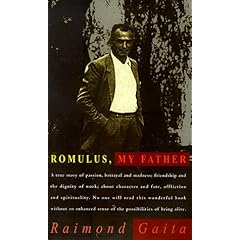
BR: Romulus, My Father (Raimond Gaita)


Amazon Link: Romulus, My Father

Written as a recollection, not as a present experience, this story spans 50 years in just over 200 pages. There is no room for detail, for sharing the journey, rather the reader bears witness and connects through empathy. It’s like sitting in an older person’s living room and listening to their life story – something I very much enjoy doing if the experiences are vastly different from my own, and these are. Through Raimond’s words, he offered me an opportunity to witness his childhood, the observations and interactions he had with his parents, family friends, and the wider relevance of immigrants assimilating into the Australian culture – something my own mother and grandparents did around the same time as Raimond’s.

Romulus Gaita (Raimond's father), an immigrant to Australia from Yugoslavia, lived an unthinkably difficult life. Raised with violence, Romulus knew pain, hardship, living without. He strived to shield his son from the same and this book proves his success. Through Raimond’s memories, I developed a deep respect for Romulus, his family, the people he interacted with and for the toll mental illness takes.

Romulus chose a passionate woman in Christiana (Raimond’s mother), but she came with huge problems. Romulus’ pride, his high morals, his honour, prevented him from blaming her for her failures (and there were many), and it also had him supporting her when she betrayed him to another man (many other men, it seems). A lesser man would have cast her aside: Romulus did not because he said there is no worse fate than mental illness, and Christiana was deeply unwell. The pride and compassion of this man was inspirational, it highlights the difference between cultures and the generosity of spirit that allowed him to co-exist with Australians who did not immediately appreciate and share those virtues.

Raimond writes with pride, with strength, and I can’t help but share the admiration he holds for his father and for the people he writes about. As a child, Raimond experienced grief, loss, abandonment, confusion that no child should ever experience, yet he never doubted his father’s love for him, and he was never without support.

This story is amazing, made all the moreso because it’s true.

Rating ***1/2 (out of *****)

Sunday, 23 September 2007

BR: The Broken Shore (Peter Temple)


Amazon Link: The Broken Shore

Peter Temple writes with a succinct eloquence: simple beautiful words that craft a tapestry of emotion, imagery and sensation. Though this is a crime novel (a genre that I tend to avoid) it’s the beauty of the writing and the Australian setting that makes this an incredible read.

Joe Cashin is a senior detective with the Victorian Police, a smart man with a nose for the darker side of life. He can tell when a person is lying, and is ceaseless in his persistence for the truth. This dogged intensity earned him a high profile in the force, the respect and disdain of his colleagues, near cost him his life and (arguably) resulted in the death of a young officer who walked too closely in his shadow. Wracked with pain and guilt, his confidence abraded, Joe keeps the peace in Port Monro, a small coastal town where nothing much happens. In his spare time he restores his late father’s house and tries not to think too much. He’s in stasis, but life won’t leave him alone.

The murder of an elderly millionaire pushes Joe back into the job and shines a media spotlight on Port Monro. When three local Aboriginal youths are connected to a watch thought to be stolen from the dead man, Melbourne put Joe in charge to bring the boys in. With aboriginal deaths in custody a hot political topic, and one of the youths the cousin of an up and coming politician, it is imperative that the intercept is done right. It isn’t. It goes awry – a brilliant, bloody disaster. Two of the boys are killed; the third left injured and traumatised. Police harassment drives the boy to suicide. The police are cleared, claiming they acted in self defence in difficult circumstances and the locals (racist and intolerant) consider that justice has been served. Joe doesn’t think so, and works to uncover the truth.

In many ways this is a crime novel, and if it weren’t for the simplistic beauty of the writing, I would not have been so engaged. I focussed on the writing, on Joe, the characters with whom he directly interacted. Early on in the book he takes in a swaggie, a drifter with no fixed address: Dave Rebb. Softened by the trauma he endured, Joe offers Rebb a job instead of locking him in the cells and running background checks. In Rebb, Joe finds a friend. It’s tentative, masculine, painfully hesitant, but Joe connects and accepts. The subtly with which Peter draws the relationship between these two men is inspiring.

There is a love interest, the legal counsel who acts for the Aboriginal boy and an old school friend of Joe’s. This aspect felt just a little convenient, as though Peter offered her up to remind readers of Joe’s heterosexuality. To me, that was never in doubt.

The non-speaking stars of the novel are the protagonist’s two dogs: poodles. They feature in many scenes, yet never own any of them.

The dogs were tiring now but still hunting the ground, noses down, taking more time to sniff, less hopeful. Then one picked up a scent and, new life in their legs, they loped in file for the trees, vanished. When he was near the house, the dogs, black as liquorice, came out of the trees, stopped, heads up, looked around as if seeing the land for the first time. Explorers. They turned their gaze on him for a while, started down the slope.

The harsh coastal landscape brings an extra dimension, conveying a maudlin tone, oppressive weight, darkness.

Cashin drove to Port Monro down roads smeared with roadkill – birds, foxes, rabbits, cats, rats, a young kangaroo with small arms outstretched – passed through pocked junctions where one or two tilted houses stood against the wind and signs pointed to other desperate crossroads.

An early reference to the abduction and rape of a male police officer by three men, and the officer’s later suicide, warn that this is a tale of moral indecency where humanity’s most basic decencies are cast aside. It follows through. The truth behind the elderly man’s death is unimaginable… but possible. The horror leaves no character unaffected, or uninvolved.

Every Australian who enjoys reading quality fiction should read this book. Sue Turnbull tells you why. If you're not Australian, read it anyway.

Rating: ****1/2 (out of a possible *****)

Wednesday, 11 July 2007

BR: Naomi's Story (Jon Casimir)

Book Link: Naomi's Story

This is a delightful, heart-warming read, something a little different from my usual choice of horror, psychological thriller and action. It’s nice to mix it up a bit. Throw in something different to the compost heap that is my writing mind.

Jon Casimir decides, even before his daughter is conceived, to keep a diary that he can pass on to her to show how loved she is. He never expected his wife, Helen, to experience such a traumatic pregnancy, and he never imagined that his baby would be born with serious health issues. Jon handles it well, but not without heart, tears and humour, and it’s his sensitivity and ability to keep his head up even when he and his wife are emotionally shredded, that makes this book a quality read. And, at times, he portrays himself in a less than bright light, and he is to be admired for his honesty.

From the outset, I fell in love with Jon’s writing style. His words flow easily; honestly, so raw that it’s hurts to witness his heartache, his helplessness to protect his baby from suffering. He carries this as a crushing weight at times, feeling that his role of protector and father is denied because of something he has done – some failure, weakness, inherent flaw that left his daughter vulnerable. It’s misplaced, of course, but guilt manifests in unfortunate ways, and when he asks a doctor which of the parents find it hardest to cope with child illnesses, it’s unsurprising to learn it’s the fathers.

In no way is this book maudlin. Jon’s humorous, dry sarcasm and self-depreciation lightens what could be a torturous read. He recognises how things could be so much worse, and aches for those who aren’t as fortunate as he and Helen… and Naomi.

The funniest part: as an Australian about to go to America for a month, I laughed out loud at Aussie-Jon visiting a Los Angeles supermarket just to ogle at the huge variety of cereals. I’m going to check this out myself. See if it really is true that the US excel at variety… I mean, how many types of cereal can there be? In a week and a half, I will find out for myself. I can’t wait!