Sunday, 14 October 2007

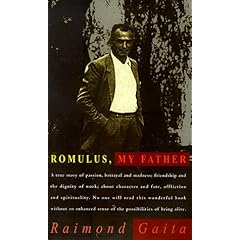
BR: Romulus, My Father (Raimond Gaita)


Amazon Link: Romulus, My Father

Written as a recollection, not as a present experience, this story spans 50 years in just over 200 pages. There is no room for detail, for sharing the journey, rather the reader bears witness and connects through empathy. It’s like sitting in an older person’s living room and listening to their life story – something I very much enjoy doing if the experiences are vastly different from my own, and these are. Through Raimond’s words, he offered me an opportunity to witness his childhood, the observations and interactions he had with his parents, family friends, and the wider relevance of immigrants assimilating into the Australian culture – something my own mother and grandparents did around the same time as Raimond’s.

Romulus Gaita (Raimond's father), an immigrant to Australia from Yugoslavia, lived an unthinkably difficult life. Raised with violence, Romulus knew pain, hardship, living without. He strived to shield his son from the same and this book proves his success. Through Raimond’s memories, I developed a deep respect for Romulus, his family, the people he interacted with and for the toll mental illness takes.

Romulus chose a passionate woman in Christiana (Raimond’s mother), but she came with huge problems. Romulus’ pride, his high morals, his honour, prevented him from blaming her for her failures (and there were many), and it also had him supporting her when she betrayed him to another man (many other men, it seems). A lesser man would have cast her aside: Romulus did not because he said there is no worse fate than mental illness, and Christiana was deeply unwell. The pride and compassion of this man was inspirational, it highlights the difference between cultures and the generosity of spirit that allowed him to co-exist with Australians who did not immediately appreciate and share those virtues.

Raimond writes with pride, with strength, and I can’t help but share the admiration he holds for his father and for the people he writes about. As a child, Raimond experienced grief, loss, abandonment, confusion that no child should ever experience, yet he never doubted his father’s love for him, and he was never without support.

This story is amazing, made all the moreso because it’s true.

Rating ***1/2 (out of *****)

Wednesday, 10 October 2007

BR: The Speed of Dark (Elizabeth Moon)


Amazon Link: Speed of Dark

In the future, science has progressed to enable people to live longer, to pay to have their brain chemistry altered so that they may enjoy greater longevity and functionality. People who commit acts of savagery are not locked in prison cells with violent recidivists, they are re-programmed, their antisocial urges removed so that they may be returned to society. In many other ways this future is no different from our present… except if you happen to have been born with autism. In this new reality, the youngest autistics are in their late twenties because autism is a treatable condition.

Lou Arrendale is 35, too old to have been given the treatment that autistic toddlers receive, but too young to be gravely dysfunctional. He works with a small group of other autistics on pattern recognition, doing work that normal people cannot do. His employer provides appropriate office accommodation, a gym with special equipment, piped music, individual offices with cheap gadgetry which allows Lou and his colleagues to manage their overstimulation. When Mr Crenshaw, a new executive with an eye for the bottom line, sets about cost-cutting, he targets the autistics. New research offers a cure, a way for them to become normal, able to function in society, to read non-verbal cues and to work without the special devices and concessions that they are currently provided. Crenshaw threatens Lou and his colleagues with termination unless they agree to the program. It’s unethical and unlawful, and it threatens Lou’s entire way of life, but Crenshaw is not the only individual gunning for Lou, targeting him because he is different. But Lou is not a victim, and he is not the moron that some people expect him to be.

Life is confusing for those of us who can process external stimuli in a way that is considered normal. We respond to facial expression and body language on an instinctual level. Lou can’t – every interaction is a struggle, facial expressions all look alike, abstract verbal constructs are confused by false meaning and illogical phrasings, and the randomness of human behaviour offers him little option for pattern recognition and forward projection. But he manages, and he manages well. Ultimately, the decision of whether to be ‘cured’ of his autism is his to make, and he makes the right decision for him. I can’t help but sense the underlying longing that the author must have for her own child (who is autistic), a wish for a cure maybe.

A cure does not change who Lou is, it changes only his ability to perceive the nuances of human interaction and thereby gives freedom from pretense. Until society embraces difference, in all its forms, people such as Lou will long for a cure, a reprieve from trying to be what they are not – an opportunity to be who they were meant to be. It’s unfair, but I applaud Elizabeth Moon for telling it like it is. There is much to be learned from this book, the least of which is an acceptance of diversity – an acceptance of ourselves.

Rating: ***1/2 (out of *****)

Tuesday, 2 October 2007

BR: Born Twice (Guiseppe Pontiggia)


Amazon Link: Born Twice

When Professor Frigerio’s second-born child, a boy, is born developmentally challenged, Frigerio questions the role he played in his son’s fate. He cheated on Franca, the boy’s mother and his wife, while she was pregnant. Maternal stress can contribute to a foetus’ development. He knows that, and suffers for it.

The story spans thirty years, taking erratic jumps back and forward as Frigerio seeks to understand his son’s limitations, and to accept them. I’m unsure he ever truly succeeds -- I'm unsure anyone can.

I found this book challenging, distressing, it hit home in a way that I had not imagined it could. At times I longed to reach in and throttle Frigerio for his emotional ineptitude, his damned selfishness! But, in hindsight,I understand him, I sympathise with him, even if I (at times) hated him.

Arguably, he mistreated his son, Paolo, left the boy stranded in a body that betrayed him and offered little parental support. When Paolo was young Frigerio wanted a photograph of him sitting on a beach. Paolo’s body refused to accommodate the father’s desire, but instead of accepting that and opting for a different pose, Frigerio persisted, ignored his son’s distress and propped him up like a doll. The boy was afraid, unable to control his muscles, he continually fell each time his parents removed their physical support. They kept trying, despite their son’s distress, consumed by their desire for a photograph they could be proud to display to their friends. I’m afraid that admission set my nerves on edge and darkened my perception of the events in the novel.

Paolo seemingly thrived despite his parents’ issues, but imagine how he might have blossomed if his father had dragged his head out of his own ass long enough to see beyond his son’s shell to the spirit within. At times he did, there are moments in this novel where Frigerio got it right, even though he wished for his child to be ‘normal’, he accommodated his son’s differences and supported him.

In reading, I wished for Frigerio to move to a point where he would love his child unconditionally, where he would be thankful for Paolo just as he was. Frigerio never reached that point, and in hindsight, I was delusional to believe he could – to believe anyone could. It’s not human nature to embrace difference, most people aspire to the norm. Seeing that in Frigerio raised some tender issues for me, but it’s nothing that I don’t feel for myself. If I were in Frigerio’s position, I’d feel the same way, and that was the hardest thing for me to accept.

Aside from the heated emotional reaction that I experienced (which is a testament to the writing style, I must admit), the book is well written. The choppiness of the telling was a little off-putting, but the word choices, the similes, metaphors, the author’s vocabulary is delightful.

I want to say I hated this book, because I did. It opened old sores, made them weep, made me ache with a sense of helpless injustice. With the benefit of reflection, and some emotional distance, I see it’s not all that bad, and Frigerio isn’t an evil, sadistic bastard who had no sense of empathy for his son. He’s a human, and the story is truthful… and the truth hurts. But, I’d prefer literary honesty than a feel good ‘happily ever after’ with no basis in reality… even if it makes me feel like a rotten piece of crap for a while.

I’m going to give this a high rating (despite my initial desire to set fire to it), because it’s well written, it’s real (Frigerio is flawed, despite his intellect), and the territory it covers is a bitter reality. I may disagree with Frigerio, but I can’t fault his truth. For that, I give this four stars. Who knows, maybe I’ll read it again and unwedge my own head from my ass, just like I wanted Frigerio to, maybe that way I'd be less like him and more evolved. It's food for thought.

Rating: **** (out of *****)

Sunday, 23 September 2007

BR: The Broken Shore (Peter Temple)


Amazon Link: The Broken Shore

Peter Temple writes with a succinct eloquence: simple beautiful words that craft a tapestry of emotion, imagery and sensation. Though this is a crime novel (a genre that I tend to avoid) it’s the beauty of the writing and the Australian setting that makes this an incredible read.

Joe Cashin is a senior detective with the Victorian Police, a smart man with a nose for the darker side of life. He can tell when a person is lying, and is ceaseless in his persistence for the truth. This dogged intensity earned him a high profile in the force, the respect and disdain of his colleagues, near cost him his life and (arguably) resulted in the death of a young officer who walked too closely in his shadow. Wracked with pain and guilt, his confidence abraded, Joe keeps the peace in Port Monro, a small coastal town where nothing much happens. In his spare time he restores his late father’s house and tries not to think too much. He’s in stasis, but life won’t leave him alone.

The murder of an elderly millionaire pushes Joe back into the job and shines a media spotlight on Port Monro. When three local Aboriginal youths are connected to a watch thought to be stolen from the dead man, Melbourne put Joe in charge to bring the boys in. With aboriginal deaths in custody a hot political topic, and one of the youths the cousin of an up and coming politician, it is imperative that the intercept is done right. It isn’t. It goes awry – a brilliant, bloody disaster. Two of the boys are killed; the third left injured and traumatised. Police harassment drives the boy to suicide. The police are cleared, claiming they acted in self defence in difficult circumstances and the locals (racist and intolerant) consider that justice has been served. Joe doesn’t think so, and works to uncover the truth.

In many ways this is a crime novel, and if it weren’t for the simplistic beauty of the writing, I would not have been so engaged. I focussed on the writing, on Joe, the characters with whom he directly interacted. Early on in the book he takes in a swaggie, a drifter with no fixed address: Dave Rebb. Softened by the trauma he endured, Joe offers Rebb a job instead of locking him in the cells and running background checks. In Rebb, Joe finds a friend. It’s tentative, masculine, painfully hesitant, but Joe connects and accepts. The subtly with which Peter draws the relationship between these two men is inspiring.

There is a love interest, the legal counsel who acts for the Aboriginal boy and an old school friend of Joe’s. This aspect felt just a little convenient, as though Peter offered her up to remind readers of Joe’s heterosexuality. To me, that was never in doubt.

The non-speaking stars of the novel are the protagonist’s two dogs: poodles. They feature in many scenes, yet never own any of them.

The dogs were tiring now but still hunting the ground, noses down, taking more time to sniff, less hopeful. Then one picked up a scent and, new life in their legs, they loped in file for the trees, vanished. When he was near the house, the dogs, black as liquorice, came out of the trees, stopped, heads up, looked around as if seeing the land for the first time. Explorers. They turned their gaze on him for a while, started down the slope.

The harsh coastal landscape brings an extra dimension, conveying a maudlin tone, oppressive weight, darkness.

Cashin drove to Port Monro down roads smeared with roadkill – birds, foxes, rabbits, cats, rats, a young kangaroo with small arms outstretched – passed through pocked junctions where one or two tilted houses stood against the wind and signs pointed to other desperate crossroads.

An early reference to the abduction and rape of a male police officer by three men, and the officer’s later suicide, warn that this is a tale of moral indecency where humanity’s most basic decencies are cast aside. It follows through. The truth behind the elderly man’s death is unimaginable… but possible. The horror leaves no character unaffected, or uninvolved.

Every Australian who enjoys reading quality fiction should read this book. Sue Turnbull tells you why. If you're not Australian, read it anyway.

Rating: ****1/2 (out of a possible *****)

Thursday, 13 September 2007

BR: Falling Boy (Alison McGhee)

Amazon Link: Falling Boy

Joseph, is a sixteen year old boy who, as a result of an accident, is now in a wheelchair. He carries a burden of guilt, of responsibility toward his mother who, as the book progresses, we learn has a mental illness. Joseph was her carer (of sorts) until the accident, now he lives with his emotionally distant father in the US Midwest, a long way from his home state of New York where his mother has been hospitalised.

He has two close friends at a café where he works: Zap a 17 year old boy and the café owner’s son. Zap is tall, lean, strong, all the things Joseph used to be before the accident. Zap watches out for Joseph and tries to act as a buffer between the world and Joseph’s inner turmoil. Enzo, a nine year old girl who asks too many questions, burns with an inner rage and confusion that initially makes her a character to dislike, and then a character to feel empathy for.

Much of the story occurs in the café. A few regulars, oddities in themselves, pass by and interact with the three main characters, but though this is Joseph’s story, it’s the others whom are just as wounded as he. Enzo needs Joseph to be something more than he is, and her continual prodding at him spurs his own emotional journey. Zap carries his own secret burden which becomes clear toward the end, just as the truth about Joseph’s accident is also revealed.

This is a satisfying novel about teenagers (and a child) dealing with adult issues of abandonment, responsibility and guilt. It’s impossible not to feel for these kids, and the conclusion brings explanation and a realistic way forward.

Well written and nicely paced.

Rating: *** stars (out of a possible *****)