Monday, 4 May 2009

BR; Out Stealing Horses (Per Petterson)

Amazon Link: Out Stealing Horses

The back cover reads:


"Out Stealing Horses has been embraced across the world as a classic, a novel of universal relevance and power. Panoramic and gripping, it tells the story of Trond Sander, a sixty-seven-year old man who has moved from the city to a remote, riverside cabin, only to have all the turbulence, grief and overwhelming beauty of his youth come back to him one night while he's out on a walk. From the moment Trond sees a strange figure coming out of the dark behind his home, the reader is immersed in a decades-deep story of searching and loss, and in the precise, irresistible prose of a newly crowned master of fiction."

This book went onto my wish list last year, and into my shopping bag this year while I was in the States. I finished reading it this morning on the train, several stops before my station. I expected resolution, a clearer explanation of Trond's psychology, his physiology even, but the book completed the story of his youth but not the story of his life. It is how it should be, and as I closed the novel in my lap and stared out the window at the city gliding past, I felt content in having experienced this journey with Trond.


He is a man who has chosen isolation, yet is unable to escape his past. Coincidence brings him a neighbour from a tragic incident many, many years before and all Trond's expectations for a solitary existence are nullified by the other man's rough companionship.


As with all great novels, animals feature heavily and their presence is not as decoration or distraction, but as a means by which the characters shift and change. Trond and Lars each have a dog, Lyra and Poker, and the two animals are strangely representative of their masters.


Trond remembers his youth and his memories are rich with a summer he spent with his father in Norway when he was 15 years old. His relationship with his father is mature, honest, absorbingly touching and ultimately saddening. One scene, whether father and son dance stark naked in the pouring rain, is hilarious and beautiful. Trond's father loves his son, respects and protects him, offering guidance and advice where necessary, and trusting distance when Trond needs to figure things out for himself. Despite their sometimes hard life, Trond is not for want of love, which makes the life his father chooses that much harder to take.


Trond's father taught him that "... we decide for ourselves when it will hurt." The lesson was in how to deal with a painfully prickly weed infestation, but this is the arc of the novel, the underlying subtext that needs multiple reads and a good book-club session to understand.


He reads Dickens, and relates some of the things that happens to stories he read long past.


... when you read Dickens you're reading a long ballad from a vanished world,
where everything has to come together in the end like an equation, where the
balance of what was once disturbed must be restored so that the gods can smile
again. A consolation, maybe, or a protest against a world gone off the rails,
but it is not like that any more, my world is not like that, and I have never
gone along with those who believe our lives are governed by fate. They whine,
they wash their hands and crave pity. I believe we shape our lives ourselves, at
any rate I have shaped mine, for what it's worth, and I take complete
responsibility. But of all the places I might have moved to, I had to land up
precisely here.

He works hard to maintain distance from people, giving them snippets of information and insight, but nothing that will reveal who he really is.


People like it when you tell them things, in suitable portions, in a modest,
intimate tone, and they think they know you, but they do not, they know about you, for what they are let in on are facts, not feelings, not what your opinion is about anything at all, not how what has happened to you and all the decisions you have made have turned you into who you are. What they do is they fill in with their own feelings and opinions and assumptions, and they compose a new life which has precious little to do with yours, and that lets you off the hook. No-one can touch you unless you yourself want them to. You only have to be polite and smile and keep paranoid thoughts at bay, because they will talk about you no matter how much you squirm, it is inevitable, and you would do the same thing yourself.

This book requires a second, third or maybe even fourth read to appreciate the subtext. It's an enjoyable read, even just for the scenery, the Norwegian and Swedish landscape and history. It's much more than that though, and it's failure to spell everything out is the richest reward of all.


Rating: *****1/2 out of five.

Sunday, 2 November 2008

BR: Peace like a River (Leif Enger)

Amazon Link: Peace like a River
The back cover reads:
Leif Enger's best-selling debut is at once a heroic quest, a tragedy, and a love story, in which "what could be unbelievable becomes extraordinary" (Connie Ogle, The Miami Herald). Enger brings us eleven year old Reuban Land, an asthmatic boy in the Midwest who has reason to believe in miracles. Along with his sister and father, Reuben finds himself on a cross-country search for his outlaw older brother who has been controversially charged with murder. Their journey unfolds like a revelation, and its conclusion shows how family, love and faith can stand up to the most terrifying of enemies, the most tragic of fates.
I'm not particularly religious, I don't believe in 'God', at least not in the 'go to church on Sunday's and say your prayers at night' type of belief. This book is riddled with miracles, real Jesus-as-our-saviour type miracles. It has a character who walks on air, a whole car and caravan being made invisible so as to evade police observation, a gas tank that never runs dry, a boy surviving a gunshot wound after he has been declared dead... and, you know what, I loved (and believed) every bit of it.

I didn't read this book from beginning to end in one sitting, in fact it took me quite some time because it's a slow book and not much happens in any great hurry, but each time I came back I settled right in and felt at home. Reuben is an adorable character. He's gutsy and young and vulnerable and real. His younger sister, Swede, is a novelist and poet, gifted with incredible insight and a vocabulary that puts mine to shame, and she's only nine years old.

Davey is the quintessential older brother: sixteen years old, fiercely protective of his family and those he loves. His honour lands him in deep trouble when he kills two intruders in the family home. His lawyer claims self defence, but there's history between Davey and the two young men, a history that unravels to reveal murderous intent.

With Davey in prison and their father out of work, things are looking pretty bleak for the Lands family. Until Davey busts out of prison and disappears. The FBI send a man out to interrogate the family, but he finds out very little because they don't know where Davey has gone. The situation enters a stalemate with the FBI man unwilling to let them out of his sight, and the Lands having nowhere to go and no way to get there. To quell her anxiety, Swede composes maudlin poetry while Reuban concentrates on breathing.
Miraculously, a local man bequeathes a car and caravan to the family, and a tank of gas that never runs out. Off they head into the barren winter wilderness in search of their lost brother and wayward son, managing to evade the FBI agent and local police as they pass through small towns.

When winter storms move in and the highway is closed, they are forced to spend a night off the highway with a widower, Roxanna. She's a friendly, ferocious woman who takes them in as her own. What was going to be one night, becomes two, three, more. They settle in, making a family for themselves but never far from their minds is Davey.

One night Reuban sees Davey on a horse at the boundary of the property. He braves the winter cold with his gummy lungs and meets with his brother. Here starts a series of clandestine meetings whereby he learns that Davey is holed up with a derelict outlaw, Waltzer, and his child bride, a brutal man with a sordid past.

Reuben is torn, bound to secrecy by his brother but fearful of the man who holds so much sway over Davey's safety. When the FBI agent, who by this stage has tracked them down, goes missing, Reuban believes Waltzer has murdered him and he's afraid for Davey's life. He tells his father who in turns tells the FBI agent and a posse is put together to hunt the men down. Reuban is dragged along and his guilt at betraying his brother is palpable.

The story takes a dramatic turn at this point and I won't give it away, but the ending is satisfying and rewarding, if not... miraculous. As Reuban says, 'Make of it what you will'.

Rating: **** out of five

Saturday, 18 October 2008

BR: The Dogs of Babel (Carolyn Parkhurst)

Amazon Link: The Dogs of Babel


The back cover reads:
This exuberantly praised bestseller - one of the year's most admired and enjoyed fiction debuts - tells the story of a man's quest to solve the mystery of his wife's death with the help of the only witness: their dog, Lorelei. Written with a quiet elegance and a profound knowledge of love's hidden places, The Dogs of Babel is a work of astonishing and lasting power - a story of marraige, survival and devotion that lies too deep for words.

This novel is one that I bought in the US last year. In fact, the last four books that I read, excluding the most recent, were books purchased last year in the US. Evidently I'm subconsciously clearing the shelves for the new books I will buy during my visit early next year.

This is a charming story, dark in places, beautiful in others, odd and disturbing when Paul's obsession with teaching his dog to talk leads him to a small group of people who believe that surgically altering the profiles of dog's jaws will give them the ability to speak.

Paul is a grieving husband, obsessed with finding out the truth of his wife's death. She fell from a tree in their backyard and the dog was the only witness. What was she doing up there? Why did she fall? Why did she cook the dog a steak before climbing the tree, and why did she rearrange their entire collection of books before she died?

Lexy left her husband a myriad of clues and he unravels them as he recalls his marraige, the highs and lows, the special things they did together and Lexy's sometimes unusual behaviour that didn't make him love her even less, but served as clues to her eventual demise.

I understand why this book made the best-seller's list, why it's a book-club book, and why it has such high praise and quality reviews. It is a quality novel that crosses genres. It has mystery and romance, it's not too long and it's not too challenging. It deals with complex issues in a manner that is accessible and not overly maudlin. It gives the reader an experience of mental illness from the outside, and it gives the reader a fluffy, light ending which readers can feel good about.

It's no wonder this is a book-club favourite and a best-seller, it packages up the nasty stuff and makes it palatable for the masses. Unfortunately I'm not one of the masses.

Paul's obsession to teach Lorelei to talk was endearing if not a little disturbing, and his embroilment with the crazy dog mutilators gave the story an aspect of danger and served to illustrate to the protagonist the error of his own ways. These are nice techniques, but they felt orchestrated rather than organic. I'd have preferred to see Paul work out for himself that the dog talking thing was flawed, which would have been much harder to pull off for the writer but inherently more rewarding for the reader.

Lexy's creativity worked well with the story and her painting of masks, especially the death masks, fed toward the eventual reveal, but the choice of making her a gifted artist is subtexturally stereotypical.

From the beginning this book didn't quite gel. The structure is mature and the pacing, though a little slow, kept me interested but the sadness is perfunctory and the writing lacked honesty. As for the whole handling of mental illness and suicide... this book sends completely the wrong message.

Readers of romance novels will enjoy this, but anyone who is seeking to understand the human condition won't get much out of it at all.

Rating: ** out of five.

Saturday, 11 October 2008

BR: Always running (Luis J. Rodriguez)

The back cover reads:

By age twelve, Luis Rodriguez was a veteran of East L.A. gang warfare. Lured by a seemingly invincible gang culture, he witnessed countless shootings, beatings,
and arrests, then watched with increasing fear as drugs, murder, suicide and
senseless acts of street crime claimed friends and family members.
This book was written in 1993, and revised with an updated introduction in 2005. Luis wrote the book, in a large part to appeal to his son in an attempt to deflect the young man from the same path he took. The introduction of this version informs the reader that his son is serving a 28 year prison sentence for three counts of attempted murder. It's a sobering start to a serious piece of work, written as a novel but with the truth of autobiography, it reads with the punch of a newspaper editorial and the poetry of lyrical prose – readable, accessible and haunting. It has lessons applicable to us all.

Luis is the son of Mexican immigrants. His parents were forced to move to the US after Luis' father, a former school principal, fell out of favour with the local chieftains – powerful men with political connections – his transgressions so dire that he was imprisoned on trumped up charges, fed food scraps from a can, treated with contempt. The family finally escaped to America and sought to build a life in the face of poverty, homelessness and social rejection.


Our first exposure in America stays with me like a foul odor. It seemed a strange world, most of it spiteful to us, spitting and stepping on us, coughing us up, us immigrants, as if we were phlegm stuck in the collective throat of this country.
Luis is one of several children but his closest and harshest sibling relationship is with Rano, his older brother.
In fact, I remember my brother as the most dangerous person alive. He seemed to
be wracked with a scream which never let out. His face was dark with
meanness, what my mother called maldad. He also took delight in seeing me
writhe in pain, cry or cower, vulnerable to his own inflated sense of power.

Displaced at home, misunderstood at school, surrounded by violence and gangs, social exclusion and minimal prospects, Luis and several other boys with similar backgrounds form a gang. They are kids, barely teenagers yet they begin their evolution into a life where alcohol and drugs numb pain, violent crime signifies strength and all that matters is blind, unerring loyalty to
their homies, regardless of personal or moral cost.

Along the spine of the night, through the shrubbery, on the coarse roads, past
the peeling shacks, past the walls filed with the stylized writing that
proclaimed our existence, past La India's shed where boys discovered the secret
of thighs, in the din of whispers, past Berta's garden of herbs and midnight
incantations, past the Japo's liquor store, past the empty lots scattered around
the barrio we called "the fields" overlooking Nina's house, pretty Nina, who
lavished our dreams, there you'd find the newest and strongest clique. There
you'd find the Animal Tribe.

Before long, the Animal Tribe is forced to disband, their members split up and absorbed by larger gangs of older boys, young men with bloodied pasts, murder and revenge in their veins. The initiations into these gangs are brutal, but Luis has grown up with pain and takes the beatings just as he takes everything else that happens to him – with numb acceptance.

Everything lost its value for me: Love, Life and Women. Death seemed the only door worth opening, the only road toward a future. We tried to enter death and emerge from it. We sought it in heroin, which bears the peace of death in life. We craved it in our pursuit of Sangra and in battles with the police. We yelled: You can't touch this!, but Come kill me! was the inner cry. In death we sought what we were groping for, without knowing it until it caressed our cheeks. It was like an extra finger in the back of our heads, pressing, gnawing, scraping. This fever overtook us, weakening and
enslaving us. Death in a bottle. In spray. In the fire eyes of a woman, stripped of soul and squeezed into the shreds of her humanity.

As a young adult, Luis begins what will be a long journey toward turning his life around. He was born with a gift of writing, and he started this book when he was 15 years old though no-one believed that a low achieving Mexican boy could (or would want to) write a novel. As he matured, he developed a healthy distaste for the daily horror, the deaths and violent reprisals, the fear of someone he loved being taken out by a warring gang. Through school, he learned that there were options and alternatives, he gained a voice, organized activities, appealed to his homies to stop the madness though very few would listen.
I arrived at a point which alarmed even me, where I had no desire for the
internal night, the buoyancy of letting go, the bliss of the void. I require
more, a discipline as a bulwark within which to hold all I valued, a shield
against the onslaught.

On a broader scale, some people listened and are still listening, others don't and never will. While he has a voice, Luis will spread his message and though he failed to save his son from prison and accepts responsibility for at least some of Ramiro's despair, the lessons he has learned and the hope he shares will save many others. That is without a doubt.

Rating: ***** out of five

Thursday, 2 October 2008

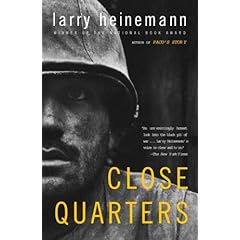
BR: Close Quarters (Larry Heinemann)

The back cover reads:

Like many other recent high-school graduates in the 1960’s, Philip Dosier found that if he didn’t have plans for himself, his country certainly did. Shipped off to Vietnam to fight in a war he knew next to nothing about, he found himself in a world of violence, fear, heat and squalor unlike anything he ever thought
could exist.

Told in the unflinchingly accurate language of the field soldier – fast, rough slang that becomes a kind of surreal poetry – Close Quarters is the story of Dosier’s year in Vietnam.

A classic of war fiction, it is the harrowing account of a decent young man who becomes an embittered combat veteran and how he makes his way back to the world he left behind.

The reader meets Philip on his arrival in Vietnam, his introduction to what will be his life for the next twelve months. He’s naïve, scared and out of place. Everything he sees and experiences is new and disorienting. The men who are already in active duty are dirty and dead eyed, rough and brutal, nothing like the guys he knows back home. All the preparation, training, instruction haven’t prepared him for the reality of what he faces, but he man’s up because he has no other option.

I stood stiffly with my feet well apart, parade-rest fashion, at the break in the barbed-wire fence between the officers’ country tents and the battalion motor pool. My feet and legs itched with sweat. My shirt clung to my back. My shaving cuts burned. I watched, astonished, as the battalion Reconaissance Platoon, thirty-some men and ten boxy squat-looking armored personnel carriers – tracks, we called them – cranked in from two months in the field, trailing a rank stink and stirring a cloud of dust that left a tingle in the air. One man slowly dismounted from each track and led it up the sloped path from the perimeter road, ground-guiding it, walking with a stumbling hangdog gait. Each man wore a sleeveless flak jacket hung with grenades, and baggy jungle trousers, the ones with large thigh pockets and drawstrings at the cuffs. The tracks followed behind like stupid, obedient draft horses, creaking and clacking along, and scraping over rocks hidden in the dust. There were sharp squeaks and irritating scratching noises, slow slack grindings, and the throttled rap of straight-pipe mufflers, all at once. And the talk, what there was, came shouted and snappy – easy obscenities and shit laughs. It was an ugly deadly music, the jerky bitter echoes of machines out of sync. A shudder went through me, as if
someone were scratching his nails on a blackboard.

The men walking and the men mounted passed not fifteen feet in front of me. A moult, a smudge of dirt, and a sweat and grit and grease stink covered everything and everyone – the smell of a junkyard in a driving rainstorm. Each man looked over, looked down at me with the blankest, blankest sort of glance – almost painful to watch – neither welcome nor distance. This one or that one did signify with a slow nod of the head or an arch of the brows or a close-mouthed sight, and I nodded or
smiled back, but most glanced over dreamily and blinked a puff-eyed blink and
glanced forward again.

Over the course of the novel, Philip becomes one of these dead eyed men. It’s a slow progression, an unnatural one, the destruction of a soul. As the back cover reads, Philip starts out as a decent guy, an average everyday Joe with a girl back home and a life ahead of him. After one year in the jungles of Vietnam, he is nothing of who he once was and bearing witness to his slow disintegration is difficult.

And I glanced up and down the two rumpled rows of cots, the two lumpy rows of sleepers. What in the world am I doing here? My parents raised me on “Thous-shalt-nots” and willow switches and John Wayne (even before he became a verb), the Iwo Jima bronze and First and Second Samuel, and always, always the word was “You do what I tell you do to.” The concept around our house was everybody takes his own lickings. But what in the name of God had I done to get this one?
Philip starts out doing ambushes: laying in wait all night in the pitch black of the jungle for the enemy to come past and hoping, and praying that he doesn’t fall asleep, doesn’t move, doesn’t screw up or he and his platoon will be dead. It doesn’t sound so bad, doesn’t sound so hard… well that’s what Philip thought too, until he started doing it.
It’s the oldest skill. You think about everything: God and the devil and pussy and what the fuck am I doing here. You sing a song to yourself or crack a joke. You squirm because you’ve got to take a leak, but you hold it until your stomach aches, and wait for morning. And sometimes if you’re a FNG, a fucken new guy, you nod out, thinking the same things you where thinking before – God and the devil and pussy, damn I wish I had some pussy. Then something starts you awake. There is a flash of light, like somebody has cracked you across the face with the narrow side of a two-by-four. You startle. And there it is just the way you left it. The woodline and the bushes and the kanai grass. You sit there red in the face, not because
you’ve nodded off, but because you have jerked awake and made the mistake of
being heard. But it is a trick of the mind. It is only your eyes that have moved. You sit there dumb, like stones and logs, as still as lake water in the moonlight. The movement is underneath – the cool water rising, the warm slowly sinking. All you heard was your heart beating, slamming against your chest, screaming again and again.

Philip’s first kill is long, drawn out; bloody hand to hand combat that culminates in Philip gaining the upper hand and choking the life from an enemy soldier, a kid younger than he. I won’t type out the scene because it is chilling and awful and there is no way that a man can come back from something like that. Worse, he is forced to stay in that cramped, pained position for hours until dawn breaks, with the body of the dead enemy soldier in his hands, his fingers locked around the other man’s neck, the dead stiff eyes staring back at him. When help finally comes and he is free to move, I sense that Philip is not the man who started out that night, he is irrevocably changed and I grieve for him – I grieve for all the young men like him.

Over the course of the year, Philip lives the life of a field soldier and the book holds nothing back, bringing into existence for the reader the reality, brutality, comradeship and compassion that exists in a war such as this. It’s a confronting and challenging read, an insight into experiences that many men would never speak openly about, but that needs to be known.

I highly recommend this novel, but appreciate that it won't appeal to all readers. There are things in this book that would be better left unknown.

Rating: ***** out of five.